
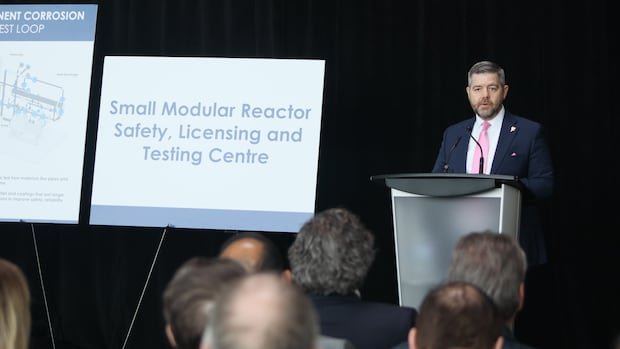
Saskatchewan is set to establish the first center in Western Canada dedicated to safety, licensing, and testing for small modular nuclear reactors (SMRs). Currently, nuclear energy accounts for 15% of Canada’s power generation, but Western Canada does not produce any of it.
The new center, located near the University of Regina at Innovation Saskatchewan’s research and technology park, will host two small modular reactor “test loops.” These loops, according to SaskPower, simulate a portion of a reactor to aid in exploring the future of nuclear power in the province.
Jeremy Harrison, the minister overseeing SaskPower, emphasized that the testing center will position Saskatchewan as a hub for “nuclear excellence” and support the development of a local “nuclear workforce and supply chain.” Harrison stressed the importance of nuclear power in the province’s energy security strategy.
Arthur Situm, the Canada Research Chair in small modular reactor safety and a University of Regina professor, highlighted that the test loops will mimic actual reactor conditions and enable researchers to study various aspects, including reactor component chemistry.
The establishment of the test loops will pave the way for post-secondary institutions in Saskatchewan to offer new training and research programs in nuclear engineering, thermal hydraulics, chemistry, and safety, as per SaskPower.
Rupen Pandya, President and CEO of SaskPower, noted that the training center will play a crucial role in attracting and nurturing the necessary talent for the implementation of nuclear power generation in Saskatchewan.
SaskPower is deliberating on the construction of an SMR in the province, with Estevan being identified as the probable location if the project materializes. Potential sites near Estevan have been pinpointed, and a final decision on the site is expected later this year.
The Crown corporation is contributing $4 million to establish the testing center, supplemented by $2 million from the federal government through Prairies Economic Development Canada, and $1 million from Innovation Saskatchewan. The Canadian Nuclear Laboratory will also provide in-kind design support, added SaskPower.