
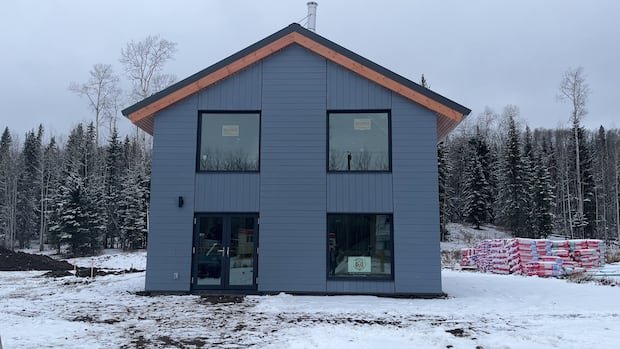
In Nak’azdli Whuten community near Fort St. James, B.C., a unique home has been unveiled as a pioneering project. This innovative dwelling serves as a model for an Indigenous-led housing initiative utilizing locally-sourced low-grade wood to create prefabricated housing kits tailored for northern regions. The pioneering approach involves harvesting trees from the local area, processing them nearby, and employing local labor to craft panels for rapid house assembly.
Elky Taylor, a member of Nak’azdli Whuten, emphasized the significance of this home, stating that it symbolizes not just housing security but also economic stability and community resilience. The collaboration between Nak’azdli Whuten Development Corp. and Deadwood Innovations, a forestry startup in Fort St. James, led to the establishment of this pilot project. Working alongside researchers from the University of Northern British Columbia’s Wood Innovation Research Lab, they designed a prefabricated mass timber panel system.
Mass timber involves bonding layers of wood to create durable structural components like panels, beams, and posts. Owen Miller, CEO of Deadwood Innovations, highlighted the uniqueness of this model home, emphasizing that mass timber construction is typically associated with large urban projects rather than regional housing for rural communities. The focus is on utilizing local resources and expertise to construct sustainable, culturally-aligned, and affordable homes that endure the test of time.
By prefabricating panels in a controlled factory environment, the quality and efficiency of construction are significantly enhanced, as mentioned by Jianhui Zhou, UNBC associate professor in wood engineering. This technology enables Nak’azdli to address housing shortages in Indigenous and northern communities by utilizing local materials and resources effectively. The goal is to establish a company that manufactures mass timber houses within the region, thereby boosting local construction capabilities.
The show home, a two-story structure with three bedrooms, two bathrooms, a loft, and an open-plan kitchen and living area, features exposed mass timber panels on three sides. Architect Neil Prakash highlighted the shift from exporting raw logs to producing finished building panels locally, a transformation made possible by repurposing the former Tl’oh Forest Products plant for panel production.
Structural engineer Mike Gehloff emphasized the adaptability of the panel system, accommodating various custom designs ranging from cabins to larger family homes. This localized approach not only caters to diverse community needs but also promotes local labor participation. The model home will serve as a showcase for the next year and a half before being gifted to a Nak’azdli family or elder, generating excitement and pride within the community for this groundbreaking initiative.