
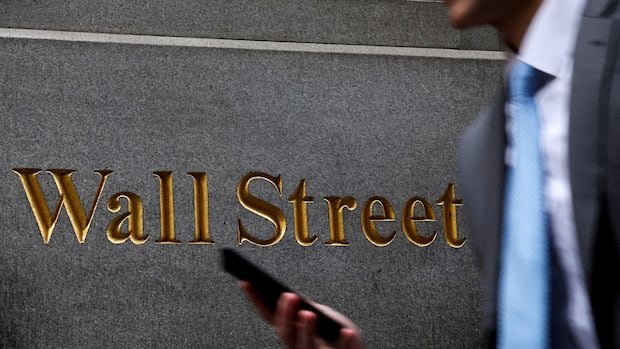
Stocks tumbled in the afternoon session on Wall Street on Tuesday following U.S. President Donald Trump’s threats to impose new tariffs on eight NATO members amid escalating tensions over his efforts to assert American authority over Greenland. The S&P 500 experienced a significant 2.1% decline, marking its largest drop since October. This was the first opportunity for U.S. markets to react to Trump’s escalation as they were closed on Monday for Martin Luther King Jr. Day.
The Dow Jones Industrial Average plummeted by 877 points, equivalent to a 1.8% drop, at 2:46 p.m. ET. Concurrently, the Nasdaq composite witnessed a sharp decline of 2.4%. European and Asian markets also experienced declines. Canada’s primary stock index was weighed down by widespread losses, with the S&P/TSX composite index dropping by 340.68 points to 32,750.28.
The decline on Wall Street was broad-based, notably driven by technology stocks, many of which hold significant sway over the market direction due to their substantial valuations. Retailers, banks, and industrial firms also recorded sharp declines.
Key industry players such as Nvidia, Amazon, JPMorgan Chase, and Caterpillar experienced notable decreases in their stock values. Conversely, companies focusing on consumer staples exhibited more resilience compared to the broader market, with Colgate-Palmolive and Campbell’s showing modest gains.
On the commodities front, the price of U.S. crude oil rose by 1.5% to $60.34 per barrel, while the price of Brent crude, the global benchmark, increased by 1.3% to $64.76 per barrel.
Trump’s announcement on Saturday regarding a 10% import tax on goods from Denmark, Norway, Sweden, France, Germany, the United Kingdom, the Netherlands, and Finland triggered repercussions across global markets. European markets experienced declines, and Treasury yields surged in the bond market.
The escalating trade tensions prompted investors to seek safety in precious metals, leading to record highs for both silver and gold prices. Gold surged by 3.7%, while silver saw a significant increase of 6.9%.
Bitcoin, which had recently been rallying, saw a dip following the trade tensions, dropping back to around $89,300 after surpassing $96,000 last week.
Trump’s aggressive stance on Greenland, linked to his dissatisfaction with not receiving the Nobel Peace Prize, has further strained relations with key allies. This has ignited outrage across Europe, resulting in discussions on potential countermeasures and diplomatic efforts to address the escalating trade and political conflict.
As world leaders convened at the World Economic Forum in Davos, Switzerland, the heightened tensions between the U.S. and Europe added a layer of complexity to the discussions. Analysts anticipate that negotiations and tensions will ease over time, minimizing the impact of the tariff threats on the broader economic landscape.
The uncertainty surrounding Trump’s tariff policies, characterized by threats, implementation, delays, and cancellations, has created challenges for businesses in planning ahead. The looming threat of tariffs exacerbating inflation poses additional complications for the Federal Reserve in its efforts to navigate the economic landscape.
Overall, the market response to Trump’s tariff threats underscores the delicate balance between geopolitical tensions, economic stability, and global trade dynamics.