
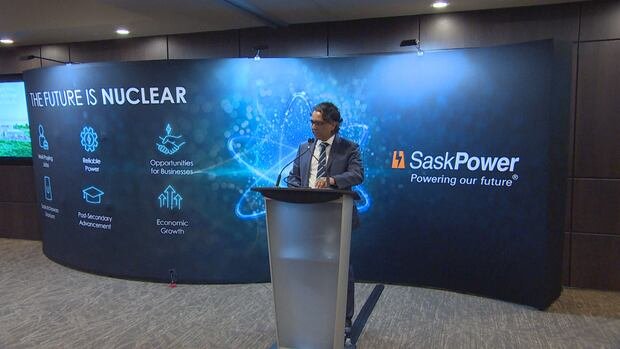
The Saskatchewan government and SaskPower have pledged to explore the development of a sizable nuclear reactor within the province. While proponents highlight the potential economic advantages of a nuclear reactor, critics emphasize the financial implications and environmental concerns that warrant careful consideration by the province.
Nuclear reactors serve as the heart of nuclear power plants, regulating chain reactions that generate heat through fission. This heat is then utilized to produce electricity by spinning a turbine using steam. The envisioned reactors would be fueled by uranium extracted from Saskatchewan, with the capability to produce significant amounts of electricity, particularly from a large-scale source.
The discussion surrounding Saskatchewan’s involvement in the future of nuclear energy has broadened due to these developments. Advocates argue that nuclear power could bolster the economy by creating numerous job opportunities and facilitating the export of energy across provinces, such as sharing power with Alberta. However, concerns about the associated costs and environmental impact persist.
The province remains committed to establishing small modular reactors (SMRs) while concurrently exploring the feasibility of a large reactor. SMRs are expected to cost between $3 billion and $5 billion per unit. Proponents suggest that a single large reactor would be more cost-effective than multiple SMRs, citing proven technologies and potential economic benefits for Saskatchewan residents.
Canada could potentially become a pioneer in utilizing nuclear energy for urban power supply, with Saskatchewan set to embrace modular reactors, following in the footsteps of Ontario’s plans for a small modular reactor by 2030. This move could create an international market for Canada, contingent upon federal government support.
However, critics argue that a large reactor would impose a substantial financial burden on Saskatchewan taxpayers. Peter Prebble of the Saskatchewan Environmental Society highlights the exorbitant costs associated with large-scale nuclear projects, pointing to examples in the United States. He advocates for alternative, more environmentally friendly energy sources like solar and wind power.
Past proposals for reactors in Saskatchewan have faced challenges, primarily due to cost and environmental concerns. While the specific site and funding for a large nuclear reactor in Saskatchewan have yet to be announced, the province has identified Estevan as a probable location for a small modular reactor.
Overall, the debate surrounding the potential establishment of a nuclear reactor in Saskatchewan underscores a complex mix of economic, environmental, and societal considerations that warrant thorough evaluation and public discourse.