
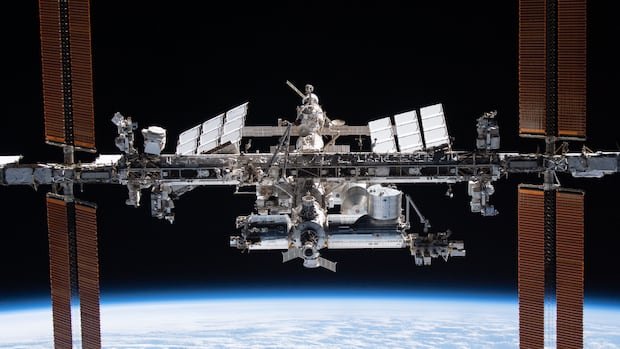
Historic structures, like Alexander Graham Bell’s residence in Nova Scotia, often transition into museums or national historic sites to safeguard their legacy for future generations. However, how does one conserve a structure the size of a football field orbiting 400 kilometers above the Earth?
NASA’s official strategy involves deorbiting the International Space Station (ISS) at the end of its lifespan, leading to a controlled descent back into Earth’s atmosphere, where it will crash in a remote ocean location. Nonetheless, recent actions by some U.S. Government members have prompted a request for NASA to reconsider this approach and explore the possibility of maintaining it in low Earth orbit instead.
Since 2000, the ISS has hosted numerous astronauts from the U.S., Russia, Canada, Europe, and Japan and has been a hub for unique experiments in a microgravity setting. Assembled over time through multiple space shuttle flights and Russian launches, the ISS, with a mass exceeding 400 metric tonnes, stands as the largest scientific laboratory ever deployed in space.
As the ISS nears the end of its operational life, NASA announced plans for its decommissioning in 2030 and subsequent deorbiting in 2031, with a SpaceX rocket designated to guide it on a trajectory to burn up as it reenters the Earth’s atmosphere. Yet, concerns have risen regarding this approach, leading to a proposal for further exploration of alternative options before committing the ISS to a fiery demise.
Various suggestions have been proposed, including boosting the ISS to a higher orbit or preserving it in orbit for potential future use. However, challenges such as the need for extensive fuel and maintenance, as well as the risk of collision with space debris, present hurdles to these ideas. Despite efforts to seek private entities interested in taking over the ISS, no viable proposals have surfaced, highlighting the difficulties in sustaining the aging space station.
While NASA shifts its focus towards lunar and Martian exploration, the fate of the ISS hangs in the balance, with uncertainties surrounding its preservation or eventual demise. As discussions continue on the best course of action, the likelihood remains that the iconic space laboratory, with its rich history and scientific contributions, may meet its end in the fiery reentry into Earth’s atmosphere, unless a more feasible solution emerges.