
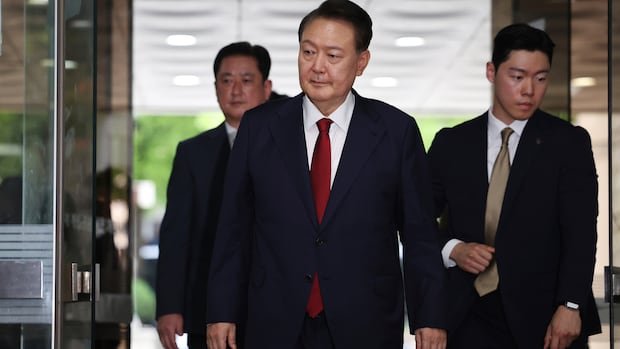
An independent counsel has called for the death penalty for former South Korean president Yoon Suk Yeol on charges of rebellion stemming from his brief declaration of martial law in December 2024. Yoon, who was ousted from office last April and is currently incarcerated, is facing multiple trials for various criminal offenses related to the martial law incident and other controversies that arose during his presidency. The most serious accusation against him is that he orchestrated a rebellion.
The counsel’s team, led by Cho Eun-suk, urged the Seoul Central District Court to impose the death penalty on Yoon, characterizing his decree as “anti-state activities” and a “self-coup.” They alleged that Yoon sought to extend his tenure by undermining the constitutional framework of governance. Yoon, a conservative, criticized the investigations into his rebellion charges as biased and accused them of manipulation and distortion.
Yoon defended his actions, stating that his decree was an effort to raise awareness about what he perceived as the threat posed by the liberal opposition Democratic Party, which he claimed obstructed his agenda using its legislative power. He argued that the utilization of emergency presidential powers should not be classified as rebellion. The court is anticipated to deliver a verdict in February, with experts predicting a likely sentence of life imprisonment for Yoon. South Korea has not carried out any executions since 1997, and death penalties have been infrequent in recent years.
If sentenced to death, Yoon would be the first former South Korean president to face such a fate since Chun Doo-hwan, who was condemned to death in 1996 for leading a military coup in 1979. Chun’s death sentence was later commuted to life imprisonment before he was eventually pardoned and released.
Yoon’s martial law declaration, the first in over 40 years, saw armed forces deployed in Seoul to encircle the National Assembly and election offices. While there were no major casualties, the incident stirred memories of past dictatorships that employed martial law to suppress dissent. On the night of the declaration, thousands protested at the National Assembly, leading lawmakers to reject the decree, ultimately resulting in Yoon’s impeachment and removal from office.
The aftermath of Yoon’s decree plunged South Korea into a period of political instability, disrupting diplomatic efforts and unsettling financial markets. Lee Jae Myung, a former Democratic Party leader, succeeded Yoon as president following a snap election in June. The new administration initiated investigations into Yoon, his spouse, and associates. The incumbent president’s office stressed the importance of the judiciary upholding the law, principles, and public expectations in the case against Yoon.
Speculation had circulated that Yoon imposed martial law to shield his wife from corruption probes. However, a recent investigation by independent counsel Cho’s team concluded that Yoon had orchestrated the martial law decree over a year to eliminate political rivals and consolidate his authority.