
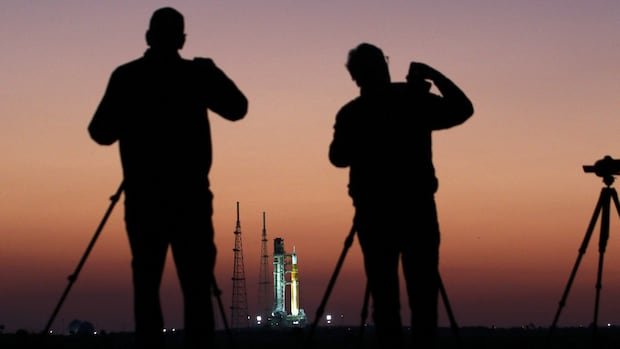
Artemis II is gearing up for its upcoming voyage around the moon and back, marking a potential milestone in human space exploration. Canadian Space Agency astronaut Jeremy Hansen, along with NASA astronauts Reid Wiseman, Victor Glover, and Christina Koch, will embark on this historic mission aboard the Space Launch System (SLS) rocket and the Orion spacecraft from Launch Pad 39B at Kennedy Space Center in Florida.
The mission’s timing presents a challenge, with multiple launch windows contingent upon risk assessment and system readiness. Previous launch attempts in February and March were postponed due to hydrogen and helium issues, as well as weather considerations. NASA indicates an 80% chance of a successful launch on April 1, with the first window scheduled from 6:24 p.m. to 8:24 p.m. ET. Subsequent launch opportunities are available nightly from April 2 to April 6 in case of a scrubbed launch.
To achieve the required orbital trajectory for the moon and back, the launch must occur at night, particularly favorable for East Coast viewers. Comprehensive coverage of the mission will be provided by CBC News, offering insights into the critical minutes leading up to liftoff.
For those interested in witnessing the Artemis II launch firsthand, email your plans to ask@cbc.ca. NASA’s detailed countdown minutes before liftoff can be explored for a deeper understanding.
CBC’s dedicated team, including reporter Nicole Mortillaro at Kennedy Space Center, will cover the launch across various platforms, providing real-time updates and highlights. The online coverage will commence two hours before liftoff on CBCNews.ca, featuring a live stream of the event and detailed recaps.
Artemis II’s trajectory will not involve a lunar landing but will test essential systems with astronauts on board. Originally intended as a precursor to Artemis III’s lunar landing mission in 2028, NASA recently revised its plans, with Artemis IV now set for a lunar surface landing.
The Artemis missions aim to establish a sustained presence on the moon for scientific and economic purposes, with an eye towards future Mars exploration. NASA’s accelerated moon base plans and the evolving lunar aspirations of other countries, such as China, underscore the global competition in space exploration.
Artemis II, expected to last around 10 days, will culminate in a splashdown in the Pacific Ocean, marking a significant step in humanity’s quest for space exploration.