
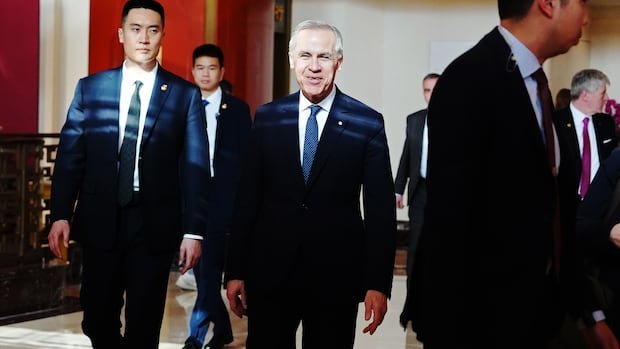
On the initial day of discussions in Beijing, Prime Minister Mark Carney and the Chinese government reached an agreement to enhance collaboration in clean and traditional energy sectors, aiming to mend strained relations between the two nations. Despite this positive step, the ongoing tariff dispute remains unresolved between the parties.
The recently established non-binding energy pact signifies the commencement of high-level talks, a significant development that had not occurred for nearly ten years, as stated by a senior Canadian official. Notably, Beijing did not commit to increasing its purchases of Canadian petroleum and liquefied natural gas (LNG) under the memorandum of understanding signed by Energy and Natural Resources Minister Tim Hodgson.
Hodgson mentioned that Chinese officials expressed a clear interest in acquiring more Canadian products. The agreement outlines discussions on oil and gas resource development, LNG, liquefied petroleum gas, and initiatives for emission reductions, building upon a previous accord.
Prime Minister Carney’s visit to China aims to move past years of diplomatic tensions and aims to double non-U.S. exports over the next decade. He is scheduled to meet with China’s President Xi Jinping later in the week. Despite positive developments, there is no immediate resolution in sight concerning Beijing’s retaliatory tariffs on Canada’s agriculture sector, including canola.
In another significant development, Canada and China signed an economic and trade co-operation “road map,” outlining strategies to boost trade following years of diplomatic challenges. Both countries agreed to enhance Canadian pet food exports to China, promote tourism, and reaffirm existing agreements to combat crime.
Industry Minister Mélanie Joly emphasized that a new era of partnership with China has begun, reflecting the positive shift in relations. During discussions with China’s Premier Li Qiang, Carney highlighted the collaborative efforts to establish a foundation for a strategic partnership between Canada and China, aiming to navigate the evolving global landscape.
As discussions progress, efforts are focused on resolving China’s retaliatory tariffs on Canada’s agricultural products, with Saskatchewan Premier Scott Moe joining the talks to facilitate potential agreements. Negotiations continue to address tariff issues, with an emphasis on persuading China to reduce levies on the agricultural sector.
Anticipating progress during Carney’s visit, Canadian officials remain optimistic about potential advancements in trade relations, albeit acknowledging the challenges posed by existing tariffs. The prime minister’s engagements in China included meetings with business leaders and discussions on potential collaborations, including exploring the possibility of increased Chinese electric vehicle production in Ontario.
The ongoing talks aim to pave the way for enhanced stability, security, sustainability, and prosperity for both nations, fostering a new chapter of cooperation and mutual growth.