
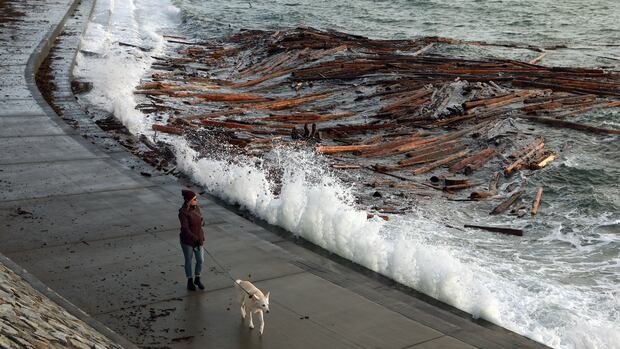
Environment Canada has canceled a special weather advisory concerning potential flooding due to stormy conditions and high tides across various areas of British Columbia’s South Coast. The warning had encompassed the majority of the Vancouver Island shoreline, the Sunshine Coast, Greater Victoria, and Metro Vancouver, predicting probable flooding as a result of high tides coinciding with a low-pressure system.
Forecasts had indicated that strong winds and waves would elevate water levels above normal levels, with the highest risk foreseen for Sunday. Data from a tidal station in Vancouver noted a peak water level of almost 5.4 meters on Sunday at approximately 7:30 a.m., while the station’s record high water level stands at 5.75 meters recorded on December 27, 2022.
Although the special weather statement has been lifted, a yellow-level snowfall alert remains in effect for a section of Highway 3 in the Boundary and Kootenay regions of southern British Columbia, with an expected snowfall of 15 to 20 centimeters along the roadway between Paulson Summit and Kootenay Pass. Avalanche Canada has reduced the risk level for the North Shore Mountains in Metro Vancouver and the Gibsons area, but emphasizes that the potential for snow avalanches remains significant from the coast to Pemberton.
Moreover, the avalanche risk is rated considerable, or level three out of five, in the southeastern B.C. mountains and along the boundary with Alberta from the Cranbrook region to north of Prince George, including Vancouver Island. The risk is moderate in the Kitimat, Terrace, and Smithers areas as well as in mountains along the southern portion of the province’s border with Alaska.