
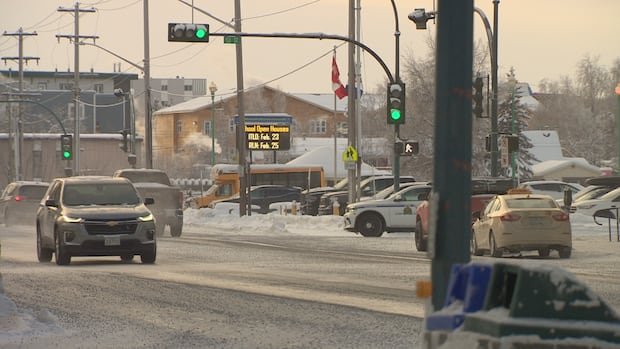
In the Northwest Territories, families earn the highest average income in Canada, but financial well-being is not uniform across the territory. According to Statistics Canada’s Canada Income Survey for 2023, the average household income in N.W.T. was $102,100, surpassing other provinces and territories by over $10,000 and exceeding the Canadian average by $27,900. However, despite this, N.W.T. had the second-highest poverty rate in Canada that year.
Statistics Canada’s research manager, Burton Gustajtis, highlighted that historically, families and individuals in the Northwest Territories have had the highest after-tax income in the country. Nonetheless, Gustajtis noted that the income disparity between N.W.T. and Canada has somewhat decreased over time, indicating slower income growth in the territories compared to the national average.
The affordability of living in N.W.T. contributes to the high wages in the region, as noted by Yellowknife-based economist Graeme Clinton. The cost of living in N.W.T. sets a higher standard for wages, reflecting the need for higher incomes to maintain a similar quality of life compared to southern regions.
Moreover, N.W.T. boasts a higher employment rate than the national average, with more individuals actively participating in the economy. Factors such as a relatively younger population and the high cost of living compelling people to seek employment contribute to the territory’s elevated employment rates.
Despite having the highest median income in Canada, N.W.T. consistently records the second-highest poverty rates in the country, following Nunavut. This paradox can be attributed to the Market Basket Measure used by Statistics Canada, which estimates the cost of maintaining a basic standard of living for families in different regions. The high living expenses, particularly in regions like Sahtu and Beaufort Delta where food transportation costs are significant, contribute to the challenges faced by families in N.W.T.
Income inequality in N.W.T. is comparable to the national average when examining the distribution of total income among high and lower earners. While the bottom 40 per cent of earners in N.W.T. account for around 20-22 per cent of total income, the top 20 per cent of earners hold 35 per cent. This distribution pattern is akin to the national income distribution.
In summary, although income data paints a picture of financial conditions in N.W.T., it does not encompass the traditional economy’s significance, such as the value derived from hunting or harvesting activities. This holistic perspective is crucial in understanding the overall well-being of individuals and communities in the Northwest Territories.