
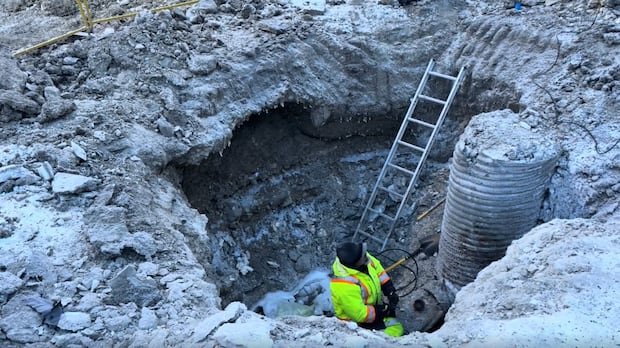
Crews in Dawson City, Yukon, braved freezing temperatures to mend two water main breaks that disrupted the community last week. The first break at Robert Service School was followed by another at the Westminster Hotel, home to the popular bar, The Pit, causing frozen pipes in several connected properties.
City officials reported on Sunday that approximately 80 homes still faced frozen lines. Collaborating with the Tr’ondëk Hwëch’in First Nation and the Yukon government Emergency Management Organization, crews and contractors are diligently working to repair the broken and frozen pipes and restore water access across the city.
According to a social media update from the city, crews are focusing on thawing out the lines on 4th Avenue and 3rd Avenue, acknowledging the unique challenges at each property. Extensive groundwork near the Westminster Hotel necessitates additional crew and equipment, which the city has mobilized for the task.
The Tr’ondëk Hwëch’in government announced on Saturday that the water main break on 4th Avenue had been fixed, with attention now turned to addressing the break on 3rd Avenue. However, the harsh weather conditions at -40°C have posed notable obstacles for the infrastructure, crews, and equipment.
In the affected area, 13 city blocks are grappling with frozen water or sewer lines, prompting a boil water order for specific establishments and a continuing advisory for the rest of the city. The city emphasized that while there is minimal risk of contamination, the precautionary boil water advisory remains in force.
Residents with frozen pipes are advised against shutting off bleeder valves and instructed to cut water and power to their hot water tanks. The recreation center will provide essential services like water access, bathrooms, and showers during specific hours, with water refill stations available at designated locations.
As the weather is predicted to improve, residents are cautioned about potential pipe breaks due to temperature fluctuations. They are also urged to tread carefully in the affected icy areas and conserve water wherever feasible.