
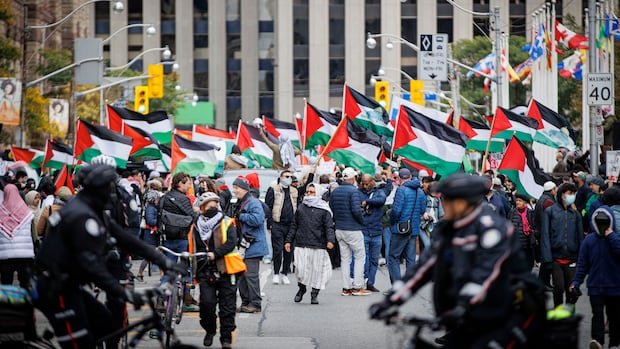
An expert specializing in free speech believes that Ontario’s solicitor general is exerting influence on the Toronto police to alter their approach to handling protests for political reasons. These concerns arose following a letter issued by Solicitor General Michael Kerzner to the Toronto Police Service (TPS) on December 30, criticizing what he perceived as a lack of enforcement against hate, intimidation, and harassment-related offenses during protests in the city.
James Turk, who heads the Centre for Free Expression at Toronto Metropolitan University, expressed unease about Kerzner’s motives. Turk conveyed to CBC Toronto his belief that the solicitor general is intervening in police operations for political purposes.
In the aftermath of the Hamas attack on Israel on October 7, 2023, and Israel’s subsequent incursion into Gaza, Toronto police have monitored over 800 demonstrations connected to the conflict, as per TPS spokesperson Stephanie Sayer. During this period, officers have conducted nearly 500 arrests and filed over 1,000 criminal charges linked to protests and hate crimes.
Furthermore, there has been an escalation in demands for stricter regulations concerning protests, which influenced the city council’s implementation of a “bubble zone” bylaw last year. This bylaw restricts protests within 50 meters of schools and places of worship under specific conditions. Kerzner’s letter aligns with these demands, spotlighting a pro-Palestinian protest at the Toronto Eaton Centre and ongoing marches in predominantly Jewish neighborhoods near Bathurst Street and Sheppard Avenue W.
Residents have expressed heightened fear and anxiety due to these incidents, feeling restricted in public spaces and concerned about the lack of visible responses, as noted by Kerzner in his letter. While CBC Toronto reached out to Kerzner’s office for a response to the criticism, spokesperson Saddam Khussain reiterated that the letter stands as the official statement.
Turk emphasized that increasing arrests and charges may not be the straightforward solution. He highlighted that democratic principles rely on continual public discourse to determine what is acceptable in society. Turk stressed that certain expressions, although offensive to some, are legal in a democratic framework, and it is not the role of the police or the province to suppress them.
Palestinian human rights activist Bashar Al-Shawwa, who relocated to Canada in 2024, echoed Turk’s sentiments, emphasizing the importance of public safety while cautioning against framing opinions as security threats. Al-Shawwa warned against the dangerous political implications of Kerzner’s letter.
Meanwhile, members of the Jewish community have expressed concerns that some protests have crossed the line, prompting calls for action. Josh Landau, the director of government relations for Ontario at the Centre for Israel and Jewish Affairs (CIJA), welcomed Kerzner’s message advocating for firm enforcement against hate, intimidation, and harassment.
While protests have faced criticism, Councillor James Pasternak reaffirmed that peaceful assembly is protected under the Canadian Charter of Rights and Freedoms. Pasternak urged for stricter measures against phrases like “globalize the intifada” and “from the river to the sea,” labeling them as hate speech. Turk emphasized that in Canada, these phrases are not illegal unless they incite violence or hatred against a specific group.
Turk emphasized the necessity of disruptive yet peaceful protests in a democratic society, cautioning that restricting such objections could lead to a more authoritarian system.