
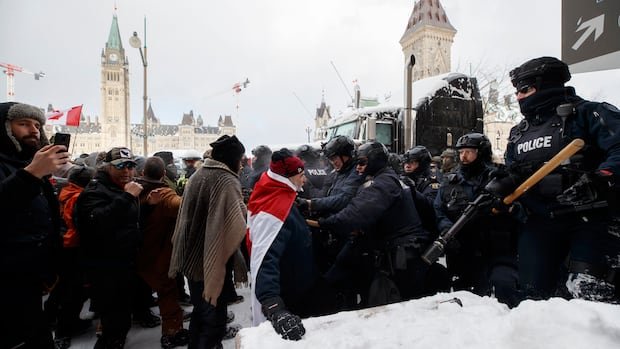
The Federal Court of Appeal ruled on Friday that the Liberal government unjustly utilized the Emergencies Act to disperse the convoy protests that paralyzed the capital city and border crossings almost four years ago. The court upheld a 2024 ruling that deemed former Prime Minister Justin Trudeau’s decision to enact the legislation as illegal and a violation of protesters’ Charter rights.
In their decision, the three judges on the appeal court stated that despite the disruptions caused by the blockades and convoy protests in Ottawa, they did not pose a significant threat to national security. The Federal Court initially reviewed the government’s controversial declaration of a public order emergency following a challenge by the Canadian Civil Liberties Association (CCLA) and other organizations.
The court found that the government lacked sufficient justification, transparency, and clarity in its decision, as pointed out by Federal Court Justice Richard Mosley in the 2024 ruling. The government’s lawyers argued during a hearing in February that the court underestimated the violence at the time of the protests. However, the appeal court agreed with Mosley’s assessment that the government did not have reasonable grounds to believe there was a national security threat warranting the use of the Emergencies Act.
Howard Sapers, the executive director of the CCLA, hailed the court’s decision as a significant win for the rule of law and the freedoms of Canadians. He emphasized the importance of safeguarding democracy while recognizing the potential necessity of the Emergencies Act in extreme circumstances but also its potential risks.
The government is currently reviewing the ruling and considering potential next steps, including a possible appeal to the Supreme Court. The Minister of Public Safety’s spokesperson reiterated the government’s commitment to ensuring the safety and security of Canadians in the face of public safety threats.
The convoy protests initially focused on opposition to vaccine mandates but evolved into a broader demonstration against the government. The government’s invocation of the Emergencies Act in February 2022 granted law enforcement enhanced powers to disperse protesters and freeze associated finances, marking the first use of the Act since its establishment in 1988.
The court of appeal also highlighted concerns regarding the identification of individuals whose bank accounts were frozen under the Act, citing a lack of rigor in the process. The legal challenge and public inquiry raised questions about the definition of “threats to the security of Canada” and the threshold for invoking the Emergencies Act, with varying opinions from different bodies involved in the review process.
Commissioner Paul Rouleau’s public inquiry differed in its assessment from the subsequent legal challenges, stating that the government had met the stringent requirements to invoke the Emergencies Act due to failures in policing and federal response. Rouleau, while acknowledging the gravity of the situation, expressed some reservation in reaching his conclusion.
The ongoing debate surrounding the government’s actions during the convoy protests underscores the complexities of balancing public safety with civil liberties and the legal parameters for declaring national emergencies.