
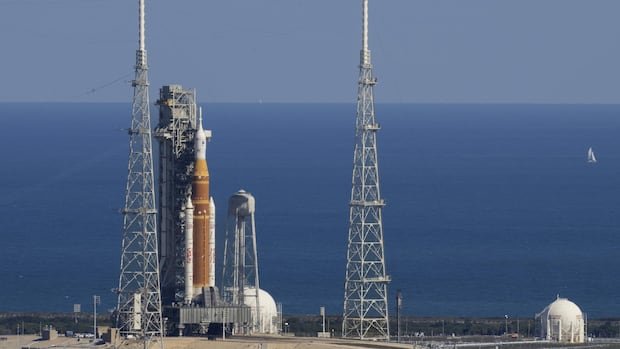
NASA encountered a leak during the fueling process of its latest moon rocket on Monday, a critical test that will determine the timing of astronauts’ launch for a lunar fly-around. The rocket, measuring 98 meters, was being filled with super-cold hydrogen and oxygen at Kennedy Space Center in Florida. Over 2.6 million liters of fuel needed to be loaded into the tanks and kept onboard for several hours to simulate the final stages of a real countdown.
However, shortly after commencing the day-long operation, an excess of hydrogen was detected near the rocket’s base, leading to a temporary halt in hydrogen loading with only half of the core stage filled. After about an hour, loading resumed but was again briefly paused before finally continuing after 4 p.m. ET.
The launch team utilized techniques developed during the previous Space Launch System (SLS) rocket launch three years ago to address the issue. Meanwhile, the crew, including Canadian Space Agency’s Jeremy Hansen and NASA astronauts Reid Wiseman, Victor Glover, and Christina Koch, monitored the rehearsal from Houston, nearly 1,600 kilometers away. They have been in quarantine, waiting for the outcome of the practice countdown.
The successful completion of this operation will determine the timing for the crew’s launch on the first crewed lunar voyage in over 50 years. A weather delay had already pushed the schedule two days behind, and NASA must launch the rocket by February 11; otherwise, the mission will be postponed until March due to the limited launch window. The mission aims to send astronauts on a nearly 10-day journey to orbit the moon and return to Earth, testing crucial systems for future lunar missions under NASA’s Artemis program.
If Canadian astronaut Jeremy Hansen cannot join NASA’s Artemis II mission, Jenni Gibbons stands ready as the backup astronaut. The mission signifies NASA’s ambition for a sustained presence on the moon, with Wiseman’s crew paving the way for future lunar explorations.