
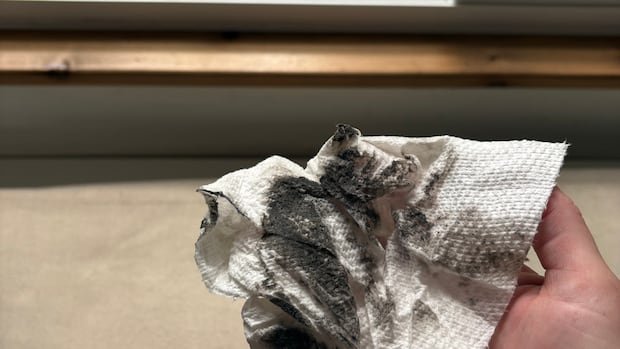
A group of scholars based in Hamilton has uncovered insights into the issue of soot settling on neighborhoods adjacent to the city’s industrial zone. Residents have long voiced concerns about a dirty, dark substance enveloping their properties, with a recent surge in complaints in early July marking a particularly severe episode.
Sarah Styler, an associate professor specializing in environmental chemistry at McMaster University, and Grace Yao, a doctoral candidate in Styler’s research group, are part of a project titled “What’s the Grime?” aimed at addressing this very question. Through collaborative efforts with volunteers who gathered samples across the city in 2024 and 2025, the researchers identified toxic elements in the soot consistent with coal combustion. Additionally, elevated levels of dust and polycyclic aromatic hydrocarbons (PAHs) were detected in proximity to the industrial precinct in northeast Hamilton.
Styler collaborated with Environment Hamilton on this initiative, supported by a $15,000 grant awarded by the university in 2024. Styler, residing in east Hamilton, and Yao, residing in Corktown, both experienced firsthand encounters with the soot. The persistent nature of this issue was emphasized by Styler, who highlighted archival references tracing back to the 1950s.
The study entailed the use of sampling kits distributed to 50 volunteers across the city to collect soot samples. These samples were analyzed at four-month intervals, revealing a pattern of increased dust deposition closer to the industrial sector, along with higher concentrations of toxic compounds in that vicinity. The team’s findings, which encompassed 13 different PAHs, suggest that coal combustion plays a substantial role in generating the identified PAHs.
While the study acknowledges limitations in comprehensively examining all substances present in the grime, the researchers underscore the significance of coal combustion in producing the toxic compounds under scrutiny. Styler underscored the necessity for enhanced monitoring and analytical capabilities to pinpoint the specific industrial sources contributing to the PAH emissions.
The research outcomes, although foreseeable for residents directly impacted by the fallout, shed light on the industrial emissions as the likely source of the soot. Nonetheless, community members have expressed frustration over the perceived lack of information from official channels. Government testing revealed that particulate matter was primarily road dust in 2024, although Styler’s team asserts that their findings contradict this assertion.
Styler stressed that the team’s research aligns with the community’s longstanding claims attributing the soot to industrial activities. The upcoming community meeting on Aug. 20 will serve as a platform for sharing these findings, with plans to broaden the study’s scope to include 200 volunteers and explore additional compounds present in the grime. Furthermore, the researchers aim to delve into effective cleanup strategies for addressing this environmental concern.