
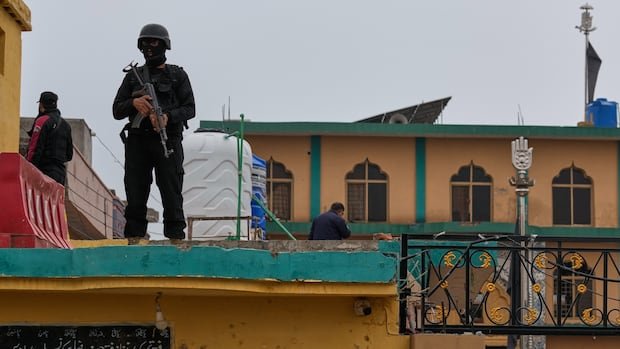
A powerful explosion rocked a Shia mosque on the outskirts of Pakistan’s capital during Friday prayers, resulting in the deaths of 31 individuals and injuring at least 169 others, as confirmed by the police.
The Islamic State group claimed responsibility for the attack in a statement posted on Telegram several hours later. Islamabad police initially classified the blast at the expansive mosque as an act of terrorism and initiated an investigation. Emergency responders and witnesses reported that some of the injured were in critical condition. Footage from television broadcasts and images circulating on social media depicted police officers and local residents rushing the wounded to nearby medical facilities.
Pakistan’s Interior Minister, Moshin Naqvi, announced on Saturday that authorities had apprehended four individuals suspected of aiding the suicide bomber. During a news briefing, Naqvi revealed that the arrests, including that of the alleged mastermind, took place following raids in Peshawar and Nowshera.
Eyewitnesses and rescuers at the scene described a distressing sight, with bodies and injured individuals scattered across the mosque’s floor. Hussain Shah, who was praying in the mosque courtyard, recounted hearing a sudden and deafening explosion. Upon entering the mosque, he encountered a chaotic scene with many wounded individuals crying out for help.
Shah estimated approximately 30 bodies inside the mosque, while the number of wounded individuals appeared significantly higher.
Pakistan has experienced a surge in militant activities in recent times, largely attributed to Baloch separatist factions and the Tehrik-e-Taliban Pakistan (TTP), commonly known as the Pakistani Taliban. Additionally, an affiliate of the Islamic State group has been active in the region.
Pakistani Defence Minister Khawaja Mohammad Asif shared on the social media platform X that initial findings indicated the suicide bomber had crossed into and out of Afghanistan. Asif noted that the mosque’s security personnel attempted to intercept the suspect, who responded by opening fire before detonating his explosives among the worshippers.
The conditions of the security guards were not immediately disclosed. Pakistan frequently accuses Afghanistan of sheltering militants and members of the Pakistani Taliban, despite Kabul denying these allegations.
In response to the attack, Afghanistan’s Ministry of Foreign Affairs released a statement condemning the violence that targeted worshippers and sacred spaces. The incident also prompted condemnation from various international entities, including the United States and the European Union, with condolences pouring in from multiple embassies in Islamabad.
President Asif Ali Zardari and Prime Minister Shehbaz Sharif denounced the attack in separate statements, extending condolences to the bereaved families and instructing the provision of comprehensive medical assistance to the injured.
Zardari emphasized, “Targeting innocent civilians is a crime against humanity. The nation stands with the affected families in this difficult time.” Sharif vowed a thorough investigation to identify and hold accountable those responsible for the heinous act.
Naqvi joined in condemning the attack and urged authorities to ensure the best possible medical care for the victims.
The incident occurred while Uzbekistan President Shavkat Mirziyoyev was on an official visit, attending an event with Sharif in Islamabad, several kilometers away from the explosion site.
The previous deadly attack in Islamabad dates back to 2008 when a suicide bombing targeted the Marriott Hotel, claiming 63 lives and injuring over 250 individuals. In a separate incident in November, a suicide bomber struck outside a court in Islamabad, resulting in 12 fatalities and 27 injuries.
This recent attack follows closely on the heels of multiple assaults by the outlawed Baloch Liberation Army in the insurgency-plagued Balochistan province, resulting in approximately 50 casualties. The military reported that in response to these attacks, security forces eliminated over 200 militants.