
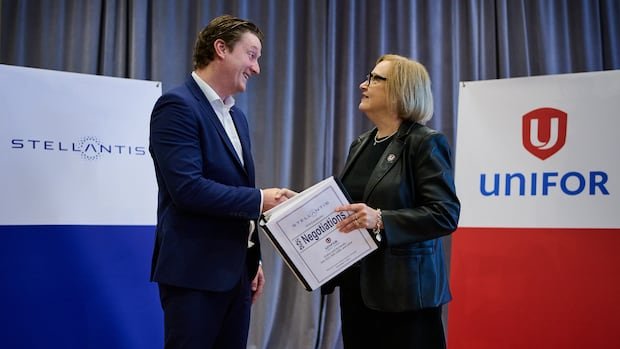
The labor union representing employees at Stellantis has cautioned the American automaker against undervaluing Canadian workers as contract discussions between Unifor and the company commenced on Tuesday. This negotiation phase signifies the final round of bargaining between Unifor and the Detroit Three automakers, with Unifor employing a pattern bargaining approach to establish terms it aims to replicate with other firms.
Despite recently approving new collective agreements with Ford Motor Co. and General Motors in Canada, Unifor’s national president Lana Payne emphasized that the most daunting challenge lies ahead. She acknowledged the difficulties faced due to the prevailing uncertainties, tariffs, and trade disputes, expressing expectations that these negotiations could be the toughest yet.
The parties are striving to reach a new agreement by the September 11 deadline, with the union’s primary concern revolving around job security following the layoff of over 2,000 employees at Stellantis’ Brampton assembly plant, which has remained inactive since 2023.
Previously, the union was notified of Stellantis contemplating the closure and sale of the plant, which was initially slated for Jeep production before the plan was halted in early 2025. Payne reiterated the union’s stance that the relocation of Jeep Compass production to the U.S. violated the existing collective agreement, resulting in the indefinite idling of the Brampton plant.
Stellantis acknowledged the significance of the ongoing labor discussions, emphasizing the industry’s evolving trade and regulatory landscape. Trevor Longley, the chairman, president, and CEO of Stellantis Canada, highlighted the company’s substantial investments in its Canadian operations since 2022, underscoring their commitment to the Canadian market’s long-term importance.
The negotiations occur against the backdrop of U.S. tariffs impacting local automakers, with the potential for increased tariffs as announced by President Donald Trump. Unifor stressed the critical need for Canada to maintain its auto sector presence amid the challenging economic conditions.
Larry Savage, a labor studies professor, noted that Unifor faces a dual challenge of securing vehicle production in Canada while advocating against trade agreements that could harm the local auto industry. The union’s recent successes in ratifying contracts with General Motors were highlighted, showcasing wage increases and agreements mirroring those reached with Ford as part of Unifor’s pattern bargaining strategy.
The current contract talks extend beyond Stellantis, with Unifor’s overarching goal being the preservation of the Canadian auto industry amidst trade uncertainties.