
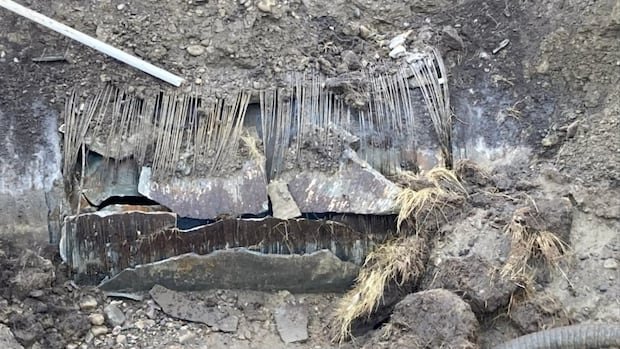
Calgary officials plan to start relaxing water usage restrictions early next week, with a return to conservation efforts expected in the spring for repairs that cannot be carried out during winter. Michael Thompson, Calgary’s general manager of infrastructure services, mentioned that the Bearspaw south feeder main has been replaced, and efforts to fill it with water equivalent to nine Olympic-sized swimming pools are in progress. Subsequent to filling the pipe, water quality tests will be conducted.
Thompson stated during a news conference on Saturday that refilling the seven-kilometer pipe requires approximately 22 million liters of water. The timeline for easing the current water conservation measures remains uncertain, but officials are hopeful it will happen by early next week. However, there is a possibility of encountering another break before the restrictions are lifted.
Calgary Mayor Jeromy Farkas advised residents to continue conserving water for a few more days, emphasizing the critical nature of the ongoing repair work. Officials also mentioned the need for additional reinforcement of the pipe in the spring, with further water restrictions anticipated at that time. The decision to delay this work until spring is to utilize snowmelt for reservoir filling.
No specific details on the upcoming restrictions were provided by Farkas or Thompson. Since December 30, when the Bearspaw south feeder main ruptured for the second time in a year and a half, officials have been urging the city’s 1.6 million residents to conserve water. The previous rupture in the summer of 2024 led to prolonged water restrictions and the declaration of a state of emergency.
Calgary’s water consumption has consistently exceeded the city’s daily threshold of 485 million liters, crucial for emergency services. Sue Henry, chief of the Calgary Emergency Management Agency, reported that Calgarians consumed 504 million liters of water the day before. She reiterated the importance of saving water, suggesting actions like reduced flushing, shorter showers, and optimizing dishwasher and laundry usage.
As the new pipe is being filled, temporary changes in water pressure, a chlorine smell, or cloudy water may be noticed by residents. Thompson reassured that these changes are normal and pose no health risks. Farkas acknowledged public frustration but emphasized the swift actions being taken to address the situation permanently.