
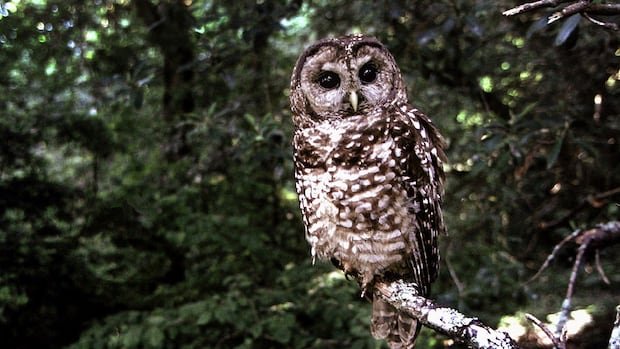
A question looms over British Columbia – are any wild northern spotted owls still surviving in the area? The last known sighting of one occurred in 2023 after a severe decline in their population over several decades.
Chief Janice Kuester of the Spuzzum First Nation expresses deep sorrow over the loss, emphasizing the significance of these owls as knowledge keepers and ancestors for their community. Since 2022, the nation has been collaborating with the province to assist in the conservation and revival of the owls.
The habitat of the species spans from the Lower Mainland through Washington state, Oregon, and northern California. While thousands of owls still exist in the U.S., the Canadian population is nearly extinct. According to Joe Foy from the Wilderness Committee, it seems that wild spotted owls have disappeared from old-growth forests in Canada, marking the apparent end of their presence in the wild.
Despite this grim reality, biologist and ecological consultant Jared Hobbs believes that reintroducing the species in British Columbia is feasible, provided that efforts to preserve their habitat are intensified. As long as suitable habitat and breeding opportunities are available, there remains hope for the species.
Efforts to issue an emergency order for the owls in 2023 were unsuccessful when the federal cabinet rejected a recommendation from former Environment Minister Steven Guilbeault. Instead, the government pledged to work closely with B.C. and Indigenous communities through an ongoing federal recovery strategy, focusing on logging and species competition as the primary threats to the owls.
Part of the recovery plan involves releasing captive-bred owls back into the wild. The Northern Spotted Owl Breeding Program in B.C. currently houses around 40 spotted owls and is actively breeding and releasing more individuals into their natural habitat.
Conservationists stress the importance of protecting critical owl habitat in B.C., covering over 4,000 square kilometers to safeguard the species. Efforts are underway to restore fragmented forests that have been impacted by logging, aiming to create suitable environments for the owls.
The existence of the spotted owls is further challenged by competition from barred owls, which dominate in terms of food and habitat availability. While the U.S. has initiated a culling plan for barred owls to aid spotted owl recovery, Canada has not implemented similar large-scale measures.
Despite the challenges, the dedication of the captive breeding facility and the involvement of First Nations offer a glimmer of hope for the northern spotted owls’ survival. In a world facing numerous species extinctions, the story of the spotted owls stands out as a beacon of inspiration amid environmental crises.