
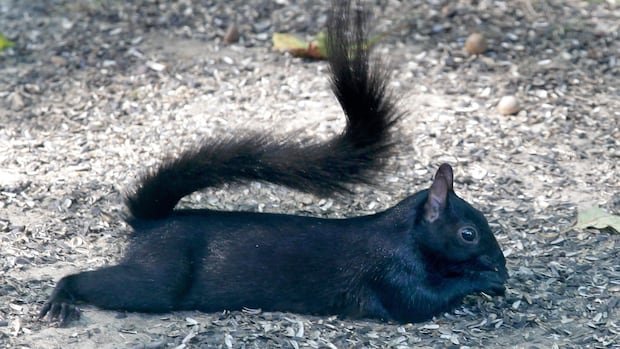
Francis Quang-Hai Dinh’s initial summer at McGill University was spent traversing Montreal-area parks on his bicycle in search of squirrels. He visited nearly 200 green spaces, ranging from Mirabel to Saint-Bruno, where he meticulously observed and documented over 800 grey and black squirrels. What started as a simple undergraduate task evolved into a personal project driven by his fascination with how the city’s layout and meandering waterways influence evolution.
Dinh, who is now pursuing integrative biology at the University of Illinois Urbana-Champaign, relied on his bicycle due to the lack of a car and limited public transportation options in suburban areas. He stands out as the sole known researcher to methodically survey squirrels park-by-park across the region.
His findings revealed that approximately 12% of squirrels in Montreal have black coats on average. However, as he ventured further north, the prevalence of black squirrels increased. In areas just north of Laval, he observed up to 40% of squirrels with black coats, while on the island of Laval, the percentage was around 20%. Conversely, on the island of Montreal, it was approximately 15%, and on the south shore of Montreal, the percentage dropped to a mere two or three percent. The study attributed these variations primarily to temperature differences, with cooler climates in the north favoring black squirrels due to their better heat absorption capabilities.
Additionally, the study highlighted the impact of forest cover on squirrel populations, noting that denser tree canopies create a darker backdrop where black squirrels are more effectively camouflaged.
Senior author of the study, Allison Roth, an assistant professor at the University of Missouri and former McGill postdoctoral fellow, emphasized that the research focuses on utilizing squirrels as a model to explore how urban environments drive evolutionary changes. Cities like Montreal, with their diverse neighborhoods, varying tree cover levels, and natural boundaries such as waterways, create nuanced environmental conditions leading to genetic and physical adaptations within animal populations.
Roth pointed out that Montreal’s segmentation by the St. Lawrence River and its tributaries creates distinct environmental microclimates, impacting squirrel populations differently across the city. This fine-scale variation is crucial for understanding evolutionary processes in urban settings.
The study, titled “Fine-scale spatial variation in eastern grey squirrel melanism across a complex urban landscape,” offers a unique perspective by examining wildlife changes on a neighborhood-by-neighborhood basis, unlike previous studies that merely compared urban and rural settings. It underscores that urbanization, while influential, is just one aspect of the complex interplay of factors shaping wildlife evolution. Urban sprawl alters local temperatures and reduces tree cover, while natural barriers like riverways also play a role in driving evolutionary changes.
The research, part of a special feature by five ecology journals focusing on collaborative data-driven approaches to ecological questions, sheds light on the intricate relationship between urban development and wildlife adaptations. Dinh, reflecting on his experience, noted a shift in his perception of wildlife and the coexistence of nature within urban landscapes, emphasizing the resilience of wildlife in adapting to human modifications.