
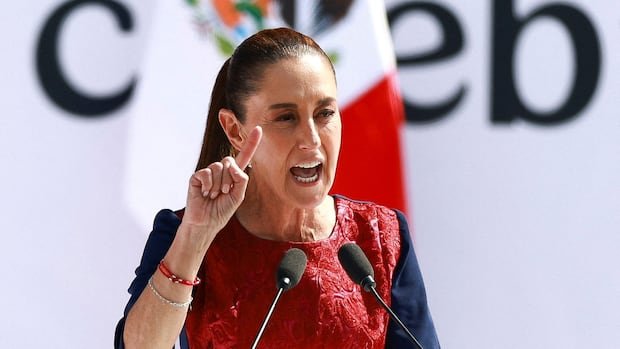
Prime Minister Mark Carney’s address at the World Economic Forum in Davos, Switzerland, had a significant impact in Mexico, a nation facing similar challenges to Canada in managing its relationship with the powerful United States. Mexican President Claudia Sheinbaum praised Carney’s speech as relevant to the current global climate during a press conference, highlighting the need for middle-power countries to cooperate amidst the disappearance of a rules-based international order.
Carney emphasized the necessity for countries like Canada and Mexico to navigate a new path amid shifting global dynamics, advocating for collaboration over competition. Both countries are working to fortify their ties in light of the renegotiation of the trilateral trade agreement with the U.S., known as the Canada-U.S.-Mexico Agreement (CUSMA) in Canada.
Governor General Mary Simon’s recent visit to Mexico, coupled with upcoming trade missions led by officials like Canada-U.S. Trade Minister Dominic LeBlanc, underscores the importance of strengthening bilateral relations. Mexican officials, including Deputy Dolores Padierna Luna and Deputy Juan Ignacio Zavala Gutiérrez, expressed support for closer collaboration with Canada to enhance negotiating positions with the U.S.
Recognizing the complementary nature of their economies, Deputy Ana Isabel González González stressed the significance of Mexico and Canada standing together to safeguard trade agreements. Mexican journalist Alex González Ormerod highlighted the strategic benefits of deeper ties between the two countries, particularly in sectors like agriculture where mutual dependence can foster resilience against external pressures.
The sentiment echoed by Mexican officials and analysts underscores the shared interests and strategic advantages of Canada and Mexico working in tandem to address challenges posed by global powers like the U.S. and China. By uniting forces, both nations aim to secure their economic interests and strengthen their negotiating positions in the face of evolving geopolitical landscapes.