
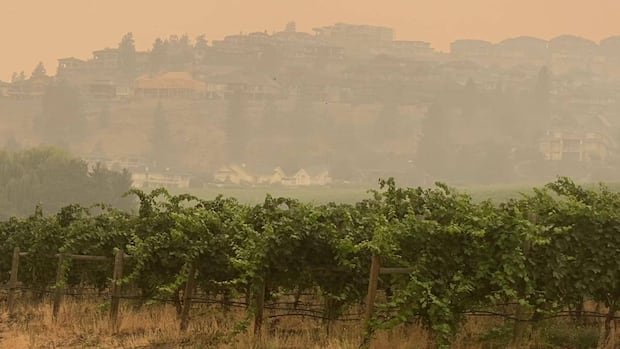
During wildfire season, wineries in British Columbia face various challenges, such as reduced tourism, labor difficulties in smoky conditions, and the threat of fires reaching vineyards. However, there’s an unseen impact that emerges post-bottling.
Smoke taint has impacted nearly all producers in the Okanagan Valley to some degree in recent years, according to Rowan Stewart, director of the B.C. Grapegrowers’ Association. He highlighted the increased prominence of this issue over the past decade.
Smoke taint occurs when maturing grapes are exposed to wildfire smoke, leading to wines with undesirable smoky, ashy, or sooty aromas, rendering them unattractive and unsellable, explained Wesley Zandberg, an associate professor of chemistry at the University of British Columbia (UBC) Okanagan.
Zandberg emphasized that not all smoke exposure results in smoke taint, but even a small amount can spoil a batch of wine. The severity of smoke taint depends on various factors, including the age of the smoke and the grape’s growth stage at exposure.
The unpredictability of smoke taint poses a significant concern for wineries, as Stewart noted. Despite efforts to test grapes for smoke taint in labs, the accuracy of prediction remains a challenge, with tainted batches occasionally surfacing unexpectedly.
Researchers, including Zandberg, are actively seeking solutions to mitigate smoke taint’s impact, but consistent protective measures remain elusive. Gill, a vineyard owner in the Okanagan, shared his struggles with smoke taint affecting up to 10% of his grapes in recent years, leading to crop losses and revenue setbacks.
As wineries navigate the complexities of smoke taint, the industry remains vigilant, knowing that the influence of this phenomenon is beyond their control, emphasizing the resilience and determination of farmers in facing these challenges.