
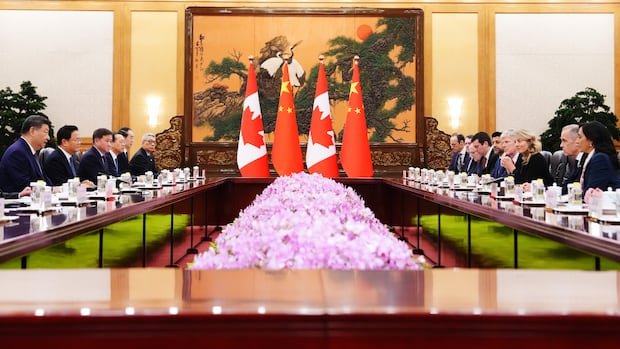
Canada and China have sealed a significant trade agreement, hailed as a “landmark” deal by Prime Minister Mark Carney. The pact signals a shift towards a more practical and mutually beneficial relationship between the two nations. This agreement follows a decade of strained ties and includes provisions to adjust tariffs on specific goods.
The agreement stipulates the entry of 49,000 Chinese electric vehicles into the Canadian market at a reduced tariff of 6.1%. In return, China is expected to decrease tariffs on Canadian canola to 15% by March and eliminate tariffs on Canadian canola meal, lobsters, crab, and peas until at least the end of 2026. Progress has also been made to address issues concerning Canadian pork exports, although Chinese tariffs on pork remain unchanged.
The discord between the two countries began over a year ago when Canada imposed a 100% tariff on Chinese electric vehicles, mirroring a similar action by the U.S. China retaliated by imposing tariffs on various Canadian agricultural products. Prime Minister Carney’s diplomatic efforts culminated in a meeting with Chinese President Xi Jinping in South Korea, marking a turning point in Canada-China relations.
The deal has drawn mixed reactions from Canadian premiers. While Saskatchewan Premier Scott Moe views it as a positive step, Ontario Premier Doug Ford has criticized the agreement, expressing concerns about the potential impact on the auto sector. Industry stakeholders have also voiced contrasting opinions, with canola farmers welcoming the deal for providing certainty, while the auto industry has raised apprehensions about potential risks and negative consequences.
As the trade agreement unfolds, all eyes are on the U.S. for its response, especially with the upcoming review of the Canada-U.S.-Mexico Agreement. Despite differing views on the deal, it represents a significant development in Canada-China relations and trade dynamics.