
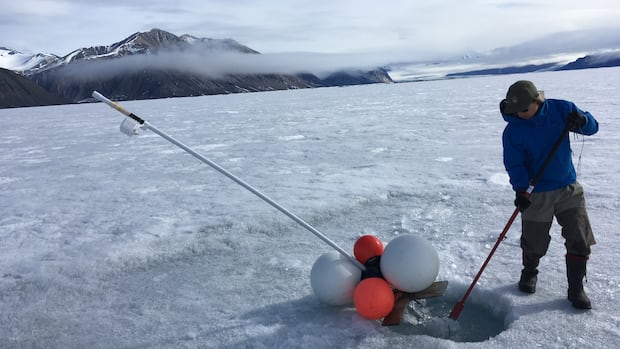
Scientists have confirmed the disappearance of Canada’s last remaining epishelf lake, which consisted of freshwater floating atop saltwater, along with the distinctive ecosystem it housed.
Jérémie Bonneau, the study’s lead author and an assistant professor at Laval University in Quebec City, expressed sadness over its loss, stating that the Milne Fiord epishelf lake on Ellesmere Island in Nunavut was “the last of its kind in Canada.”
“All of a sudden, it’s … vanished, taking with it everything that thrived within it,” Bonneau remarked.
He pointed out that the total eradication of a phenomenon that was once common is indicative of the significant changes occurring in the Arctic due to climate warming.
Although scientists had previously reported the lake’s disappearance, the recent study, published in the journal Scientific Reports, elaborates on the circumstances of its loss and states that this irreversible change “represents a regime shift and signals the conclusion of a 4,000-year period.”
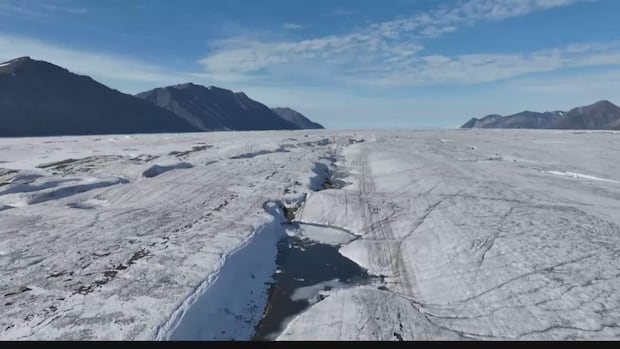
Two years after the collapse of the Milne Ice Shelf comes another major change. The disappearance of Canada’s last remaining epishelf lake. The Milne Ice Shelf was a critical part of that rare Arctic ecosystem.
Formation of epishelf lakes
Glaciers behave like rivers of ice, typically flowing into the ocean, where any meltwater on their surface also drains. This freshwater is usually mixed swiftly with seawater due to wind and waves.
However, the mouth of Milne Fiord has been blocked for thousands of years by the Milne Ice Shelf, a vast, flat ice formation attached to the northern shore of Ellesmere Island.
This barrier prevented freshwater from entering the ocean, allowing it to gather atop the saltwater of the Arctic Ocean, creating a floating layer since freshwater is less dense than its saltwater counterpart.
Additionally, a thick ice layer, measuring between 50 and 100 centimeters, covered the lake throughout the year, shielding the freshwater and saltwater layers from winds that could mix them, rendering the lake invisible from above.
Bonneau mentioned that the lake in Milne Fiord has likely existed and been accumulating freshwater for over 4,000 years.
When the lake was first measured in 1983, the freshwater layer was found to be 18 meters deep, comparable to the height of a six-story building, as noted by Andrew Hamilton, a researcher from the University of Alberta and co-author of the study.
While some epishelf lakes are entirely situated above an ice shelf — as the term “epishelf” indicates — the Milne Fiord epishelf lake was actually linked to the ocean via an under-ice channel in the ice shelf, which has been thinning for about a century.
A distinct ecosystem
Researchers examining the bacteria, viruses, and phytoplankton in both layers of the lake found almost no overlap between the freshwater and saltwater communities that were merely 20 centimeters apart.
Bonneau remarked, “It’s essentially two unique ecosystems within the same water column, which is not found elsewhere.”
Mary Thaler, who previously studied the lake’s water for DNA but did not participate in the recent study, explained that while humans or fish could easily traverse the invisible boundary between the freshwater and saltwater, for single-celled organisms, it presents “an unbreakable barrier.”
Thaler and her colleagues at Laval University found bacteria and more complex eukaryotic microbes, similar to plant and animal cells, along with viruses. Some of these species typically inhabit sediments rather than floating in the water. Notably, certain microbes identified in the lake had never been documented in the Arctic before.
Moreover, the lake’s influence extended beyond its confines. Hamilton deployed a remotely operated vehicle (ROV) into the channel of the ice shelf, where freshwater flowed out from the lake, mixing with saltwater and transporting nutrients to depths that would not have been accessible otherwise.
The footage captured revealed ghostly sea anemones, scallops, and sea stars thriving in complete darkness beneath 10 meters of ice, nourished by the nutrients flowing from the epishelf lake.
“We were truly amazed to discover a fully vibrant ecosystem thriving within this ice channel,” he stated.
The fate of the lake and its residents
In 2020, the Milne Ice Shelf fractured off the coast of Ellesmere Island, causing its wall to no longer contain the lake.
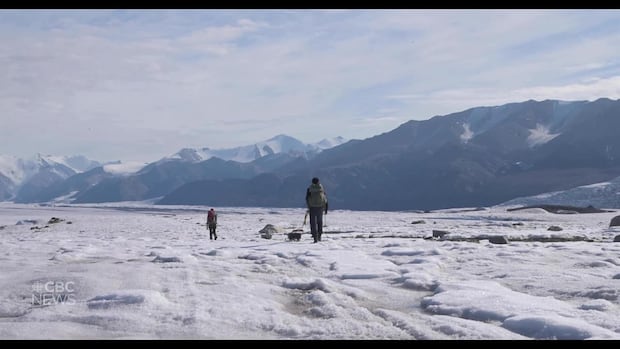
After the Milne Ice Shelf on the northern coast of Ellesmere Island collapsed in 2020, a lake it was supporting disappeared. Scientists returned north this summer to try to understand what that could mean for the island’s glaciers.
The recent study investigates what transpired with the ice and the lake before and following the collapse.
Researchers deployed moorings extending from the fiord’s floor to the surface, gauging salinity at various depths.
The findings indicated that within two months after the ice shelf’s disintegration, the freshwater had completely drained from the fiord.
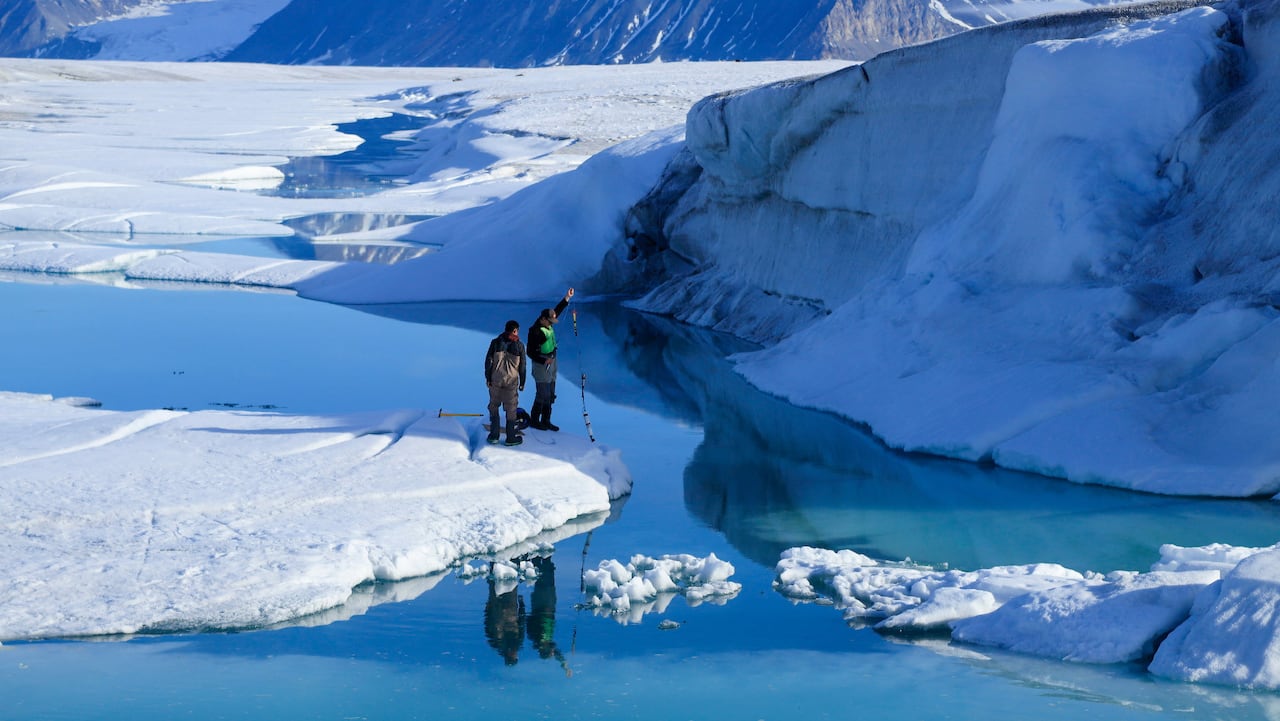
Researchers Joseph Shoapik, left, and Jérémie Bonneau measure the temperature and salinity of the water through rifts in the Milne Ice Shelf in 2022. The ice shelf broke apart, forming such rifts, in 2020. (Cameron Fitzpatrick/Water and Ice Research Laboratory/Carleton University)
Thaler observed that the freshwater organisms residing there would have perished almost instantly upon contact with seawater.
While the freshwater lake maintained an ice cover year-round, the saltwater fiord is ice-free during parts of the summer, allowing for warming and mixing by wind and waves — creating a typical marine environment that supports organisms distinct from those that inhabited the former lake.
“This leads to a significant transformation,” Bonneau noted.
Although epishelf lakes are now entirely absent from Canada, a few can still be found in Greenland and Antarctica.
“Regrettably,” Hamilton stated, “I believe their existence is limited…. This emphasizes that we are on a one-way path for some of these remarkable ecosystems that contribute to the splendor of our planet.”