
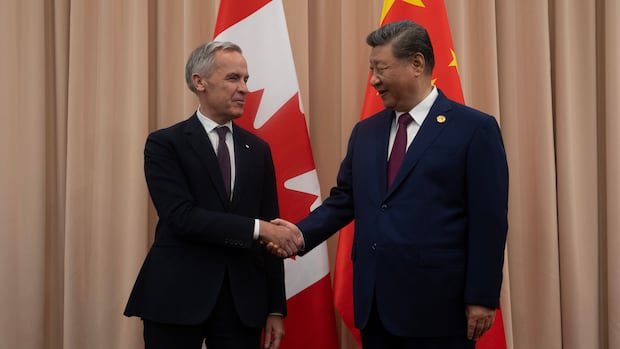
Prime Minister Mark Carney is currently in South Africa attending the G20 summit, an event that notably does not have the participation of the world’s largest economy. This move by U.S. President Donald Trump is viewed as part of a broader shift in global dynamics. Canada is actively seeking to broaden its international relationships due to an increasingly uncertain and unsteady bond with the U.S., with a specific focus on strengthening ties with China. Prime Minister Carney has initiated efforts in this direction, as evidenced by his recent meeting with Chinese President Xi Jinping during the Asia-Pacific Economic Cooperation summit in South Korea. Carney described this encounter as “long overdue” and a “significant moment in the relationship.”
Despite being a latecomer to engaging with China, Canada aims to double its non-U.S. exports over the next decade under Carney’s leadership, signaling potential benefits from this strategic shift. While China stands as Canada’s second-largest trading partner after the U.S., accounting for around $30 billion in Canadian exports in 2024, this figure represents only about five percent of Canada’s total exports, in stark contrast to the roughly 75 percent of exports directed towards the U.S.
Experts suggest that resolving the trade conflict between Canada and China, including the removal of Canada’s 100 percent tariff on Chinese electric vehicles, could be a vital initial step towards diversifying and boosting trade with China. Currently, China has imposed counter-tariffs on Canadian products like canola, seafood, and pork, leading to significant financial repercussions. Addressing these trade tensions has become more pressing as relations with the U.S. have deteriorated.
In addition to trade, there are opportunities for collaboration with China in various sectors such as research and development, manufacturing, and services. Notably, China’s advancements in technology present avenues for mutual growth and cooperation. Embracing partnerships in areas like electric vehicle technology and AI could pave the way for enhanced economic ties between the two nations.
Soft power tactics, including educational and tourism exchanges, offer promising avenues for fostering stronger relations between Canada and China. By leveraging shared economic interests and addressing past challenges, both countries stand to benefit from enhanced collaboration in various sectors. As Canada navigates its evolving relationship with China, policymakers are urged to approach this strategic shift with a clear understanding of the risks and complexities involved, including considerations related to human rights and cybersecurity.