
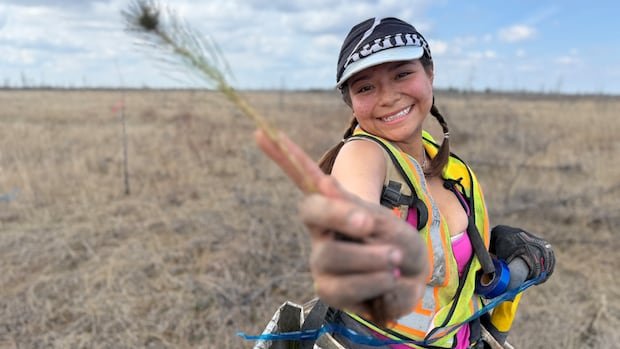
Marley Moose, a 22-year-old, is currently dedicating her third summer to reforesting areas in northern Manitoba that were devastated by wildfires. Despite her efforts and those of her crew, the task has become more daunting due to the discontinuation of a federal initiative set to plant two billion trees by 2030.
The forest in Manitoba’s Interlake region suffered a jack pine budworm infestation in 2016, followed by a wildfire in 2021 that ravaged the Devils Lake area as it was starting to regenerate. Moose, actively planting jack pine and black spruce trees, expressed her commitment to revitalizing these scorched landscapes.
Nekoté LP, an Indigenous-owned corporation representing seven Swampy Cree First Nations, is spearheading the tree-planting program Moose is part of. The initiative aims to restore the land and empower Indigenous communities to take stewardship over their territories.
The Canadian Tree Nursery Association (CTNA) highlights the urgent need for reforestation efforts, as Canada is losing trees faster than they can naturally regenerate or be replanted. Factors like deforestation for development, lumber, paper production, and pest infestations contribute to the decline of forest cover.
The CTNA’s 2 Billion Trees Program, launched by former Prime Minister Justin Trudeau, was abruptly canceled by the current government last fall. This decision has put projects like the Nekoté LP tree-planting initiative at risk, jeopardizing the reforestation efforts crucial for combating wildfires and mitigating climate change.
With Canada facing consecutive severe fire seasons and struggling to maintain carbon sinks in its managed forests, the need for tree-planting initiatives has never been more critical. The cancellation of the 2 Billion Trees program has sparked collaboration among industry stakeholders to find alternative funding sources and innovative solutions to sustain reforestation efforts.
Farron Sharp, a project manager with Blue-Green Planet Project, is actively seeking new funding avenues to support tree-planting initiatives in Manitoba’s Devils Lake area. With a goal of planting 20 million trees by 2030, Sharp emphasizes the importance of investing in reforestation as a way to counterbalance environmental degradation caused by human activities.
As Moose and her team continue their arduous tree-planting work, they remain driven by a shared vision of restoring the forests for future generations. Their dedication reflects a deep-rooted commitment to preserving the natural environment and combating the impacts of climate change.