
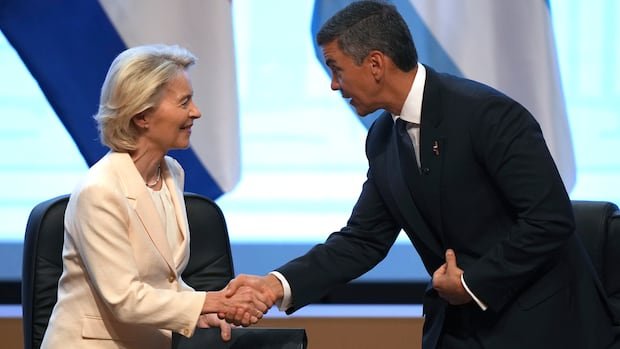
The European Union and Mercosur, a South American trade bloc, have officially signed a significant free trade agreement after over 25 years of challenging negotiations. The signing event in Asunción, Paraguay, signifies a strategic victory for the EU amidst global trade tensions and protectionist policies.
The agreement strengthens the EU’s presence in a resource-rich region, which has become a focal point for competition between the United States and China. It also underscores South America’s commitment to diverse trade relationships despite U.S. President Donald Trump’s emphasis on American dominance in the Western Hemisphere.
European Commission President Ursula von der Leyen highlighted the geopolitical importance of the deal, emphasizing the EU’s preference for fair trade over tariffs and the importance of long-term partnerships. The ceremony was attended by leaders from Mercosur countries and Brazil’s foreign minister.
The agreement, which eliminates more than 90% of tariffs between the two regions, establishes one of the largest free trade zones globally, encompassing over 700 million consumers and a quarter of the world’s GDP. While the deal faces a final hurdle of ratification by the European Parliament, concerns from protectionist groups, especially European farmers worried about competition from South American imports, could potentially delay its implementation.
Despite the tariff reductions, certain tariffs will be phased out gradually over a decade or more, and strict quotas will be placed on key agricultural products like beef to address European farmers’ concerns. Italy supported the agreement earlier due to these quotas and EU subsidies for farmers, while France still opposes the deal.