
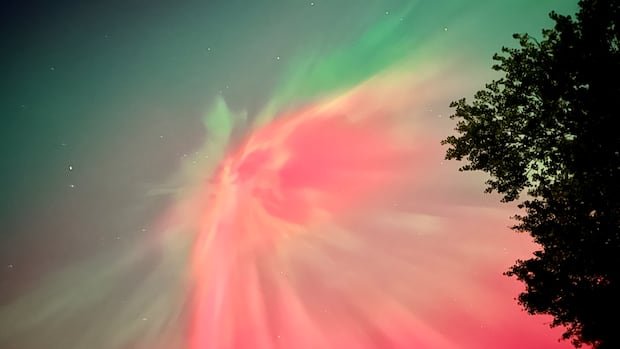
Canadians may witness a stunning northern lights display tonight as Earth is hit by fast-moving particles from the sun. The sun has been active recently, releasing magnetic energy and three bursts of fast-moving particles known as coronal mass ejections (CMEs). These CMEs are rapidly traveling through the solar wind towards Earth and could potentially merge into what scientists call a “cannibal” CME.
When these particles interact with Earth’s magnetic field, the result is the mesmerizing phenomenon known as the northern lights or aurora borealis. While typically visible in northern latitudes, a strong enough CME could extend the display further south. A memorable example was the May 10, 2024, northern lights event that reached as far south as the Caribbean, caused by a cannibal CME.
The National Oceanic and Atmospheric Administration’s Space Weather Prediction Center (SWPC) has issued a forecast for a strong geomagnetic storm tonight and into Friday. Geomagnetic storms are rated on a scale from G1 to G5. The SWPC anticipates a combined CME arrival around mid-afternoon EDT on June 4, potentially reaching up to G3 storm levels.
Forecasting the northern lights is challenging, but the SWPC expresses a reasonable level of confidence in their arrival, though uncertainty remains about their intensity. The intensity of the display is uncertain due to the complex nature of these CMEs, with G3 storm levels being the most likely consensus, and a possibility of G4 levels.
The intense northern lights displays in May and October 2024 were the outcome of G5 storm levels. To witness the northern lights, several factors must align, including the auroral hole’s southward dip, the darkness of the sky, and the timing of the storm. Observers are advised to move away from city lights for optimal viewing conditions and to utilize their phones for photography.
For those looking to capture the aurora, aiming towards the north is recommended. Apps like Aurora Now can provide real-time information on the visibility of the northern lights in specific locations. Additionally, stargazers are encouraged to observe the beautiful conjunction of Jupiter and Venus by looking west after sunset for the best celestial view.