
“Lake America” designations are now visible on Google Maps, and President Donald Trump is urging Apple to do the same by having the navigation app preinstalled on all iPhones.
Experts in the technology sector point out a concerning reality for many Canadian consumers and businesses: they are essentially “tied” to these American-owned platforms with limited non-American options available.
Anne Pasek, Canada Research Chair in Media, Culture, and the Environment at Trent University in Peterborough, Ont., emphasized that Canadians are significantly impacted by American tech monopolies, which is often overlooked until controversies arise.
“Our digital activities and much of our daily life that stems from them fall within the domain of American companies, and subsequently, American laws.”
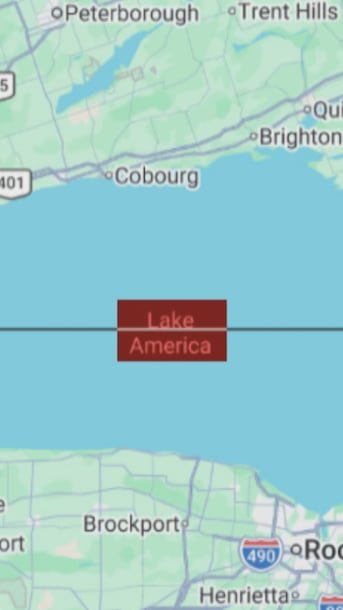
Several Canadian websites, including those of the federal government and major banks, have recently shown maps with Lake Ontario renamed as Lake America.
These alterations come in response to an executive order from Trump instructing the U.S. federal government to formally change the name of one of the Great Lakes that separates the two nations amidst an escalating trade dispute.
Google implemented the change for U.S. users and introduced an option for non-American websites to show the label “Lake Ontario” by customizing their maps and setting the region to Canada.
“These modifications align with our established policy for bodies of water with differing names across countries,” as stated by the company on Saturday.
U.S. Interior Secretary Doug Burgum informed Fox Business on Monday that Trump had reached out to Apple to request the adjustment of Lake Ontario to Lake America in its applications. Apple has not yet responded to multiple inquiries from CBC News.
In addition to offering navigation services to numerous users, mapping tools from major U.S. tech companies are integrated into the operations and websites of many Canadian businesses.
They provide crucial information such as business hours, contact details, reviews, and other essential data. In the background, they enable e-commerce platforms to autocomplete addresses and allow ride-hailing and food delivery apps to monitor traffic and road work.
“There is a noticeable monopoly,” noted Pasek. “People are locked in.”
Could Trump target tech-based ‘pressure points’ against Canada?
Emily Osborne, a policy research associate at the Canadian Shield Institute, a Toronto-based think-tank established by BlackBerry co-founder Jim Balsillie to enhance public policy on technology and national security while safeguarding Canadian intellectual property, expressed concerns.
“We heavily rely on American companies like Google and Apple for various digital services and products online, and navigation is a significant aspect,” Osborne stated.
For basic navigation, she suggested potential alternatives to Google and Apple such as Dutch companies TomTom and HERE Technologies.
Until recently, Canada had a domestic alternative. Avenza Systems, based in Toronto, was acquired by Blue Marble Geographics, headquartered in Maine, for an undisclosed amount in a deal finalized in April.
If tensions