
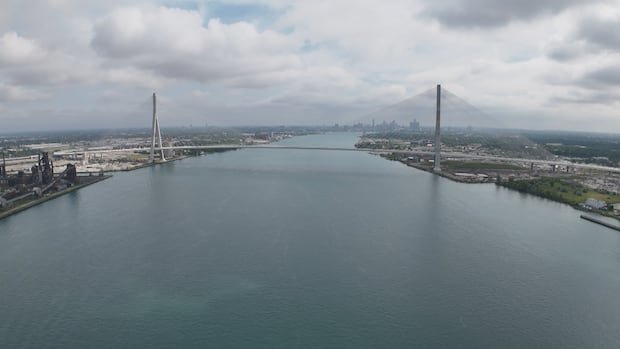
The official confirmation from the federal government states that the Gordie Howe International Bridge, connecting Ontario to Michigan, will be open for public use on July 27. A recent news release by the Department of Housing, Infrastructure, and Communities announced that Canada and Michigan reached an agreement to commence the bridge’s operations, supported by the U.S. government.
In efforts to ensure mutual benefits across the border, both Canada and the United States have agreed on a set of collaborative measures focusing on toll governance, transparency, and regional investments. This includes the establishment of a 15-year economic development fund linked to a portion of the bridge’s profits. Additionally, the Windsor-Detroit Bridge Authority will work closely with the U.S. government on toll-rate adjustments, seeking approval for specific toll changes not based on market conditions.
According to a senior Canadian government source, Canada is set to receive 50% of toll profits in the initial 15 years of the bridge’s operation, with the remaining portion allocated to a regional economic development fund. Any proposed toll increases exceeding 10% or deviations from regional averages will require U.S. consent.
Spanning approximately 2.4 kilometers over the Detroit River, the six-lane cable-stayed bridge connects Windsor, Ontario, to Detroit. Named in honor of the late Canadian hockey legend Gordie Howe, construction of the bridge, funded by Canada, commenced in 2018.
The opening ceremony, initially scheduled for June 12, was postponed as per the request from the U.S. Prime Minister Mark Carney mentioned that the delay was necessary to address outstanding issues. Former U.S. President Donald Trump had previously demanded substantial ownership of the bridge and other concessions, leading to delays and negotiations. However, a newly agreed deal allowed the bridge’s opening to proceed as planned.
The Gordie Howe International Bridge, a toll bridge co-owned by Canada and Michigan, is anticipated to alleviate congestion at the Ambassador Bridge and the Detroit-Windsor Tunnel. This strategic infrastructure upgrade aims to facilitate smoother cross-border travel for both commercial and recreational purposes between Detroit and Windsor, two historically interconnected cities.