
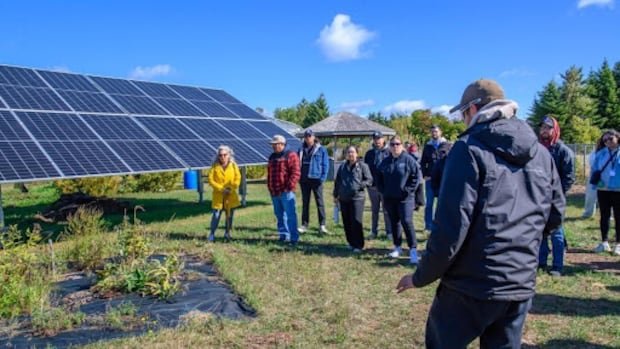
Indigenous-led or co-led renewable energy initiatives are playing a crucial role in aiding Canada’s progress towards meeting its climate objectives, according to an advocate. James Jenkins, the executive director of Indigenous Clean Energy, a non-profit organization supporting Indigenous-driven clean energy projects at the community level, noted a rise in Indigenous-owned or co-owned renewable energy projects over the past decade.
Jenkins emphasized that each emission-free project contributes to Canada’s goal attainment. Recent data from Environment and Climate Change Canada indicates that Canada is projected to fall significantly short of its 2030 climate target, achieving only half of the 40 to 45 percent reduction in greenhouse gas emissions below 2005 levels.
Highlighting the variety of operations, Jenkins, a member of Walpole Island First Nation in southwestern Ontario, mentioned hydroelectric, wind, and solar projects, along with battery storage initiatives. These renewable energy ventures not only generate revenue but also reinvest in the community, aligning with its values.
As of 2022, the Canada Energy Regulator website reported that First Nations, Métis, and Inuit communities were involved as partners or beneficiaries in approximately 20 percent of Canada’s current electrical-generation infrastructure. The website further indicated a fourfold increase in the number of renewable projects on traditional Indigenous lands between 2009 and 2020.
Noteworthy partnerships include the Six Nations of the Grand River Development Corporation and Mississaugas of the Credit Business Corporation in the Oneida Energy Storage project, a lithium-ion battery energy storage facility. According to Northland Power, the project’s majority owner, this facility stands as Canada’s largest grid-scale battery energy storage installation and is anticipated to reduce emissions by 1.2 to 4.1 million tonnes, equivalent to removing up to 40,000 cars from the road.
CBC Indigenous sought a response from Northland Power but received no reply by the time of publication. Jenkins emphasized the need for continued positive momentum from federal, provincial, and territorial leadership in supporting the construction of Indigenous-led projects, especially with the expected surge in electricity demand over the next decade.
Ross Linden-Fraser, the research lead at 440 Megatonnes, a Canadian Climate Institute data project monitoring climate policy, commended Indigenous nations for their advancements in clean electricity. He co-authored a recent report assessing the federal government’s progress toward the 2030 emissions reduction target, revealing a concerning trend away from the targets due to the removal or weakening of climate policies by federal and provincial authorities.
Linden-Fraser warned that Canada, as a wealthy high-emitting nation, must contribute to global emissions reduction efforts to combat climate change effectively. He critiqued the federal government’s report for lacking substantive corrective options assessment, despite comprehensive policy updates and emissions projections.
Acknowledging Canada’s status as one of the top 10 global greenhouse gas emitters last year, the Office of the Minister of the Environment and Climate Change pointed to various initiatives, including the Darlington nuclear expansion and hydroelectric projects, aimed at reducing emissions. The statement highlighted the Canada Climate Competitiveness Strategy introduced in the recent federal budget as a step towards emission reduction through measures like new methane regulations and investment tax credits for clean growth initiatives.