
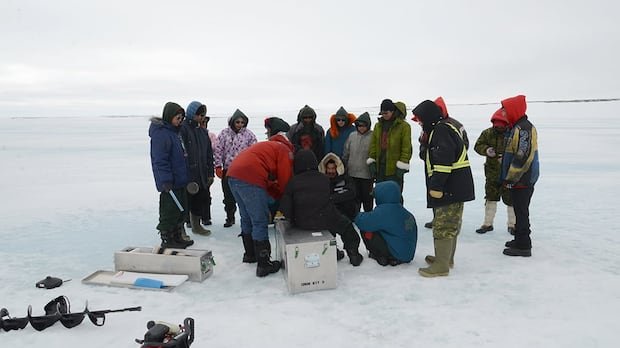
Candice Sudlovenick finds fulfillment in her role as the outreach programs manager for SIKU after starting her journey with Ikaarvik over ten years ago as a young participant. She attributes her passion for research to the empowering experience with Ikaarvik, where she discovered her voice and the value of being heard.
A recent publication in Arctic Science, co-authored by Danielle Nowosad, a postdoctoral fellow at the University of Calgary of Métis descent, delves into the methods of Inuit leadership in research. Sudlovenick highlighted the shift towards inclusivity of Indigenous perspectives and knowledge within the Canadian research landscape.
The establishment of Ikaarvik originated from a group of Inuit youth who completed the Environmental Technology Program at Nunavut Arctic College in Pond Inlet in 2010. The organization’s primary goal is to equip Inuit youth for careers that bridge traditional Inuit knowledge with scientific research, transforming obstacles into opportunities for growth.
Sudlovenick emphasized the importance of recognizing Inuit contributions beyond traditional roles in research partnerships, advocating for a more holistic approach that values Inuit expertise. Nowosad echoed this sentiment, noting the longstanding efforts of Inuit communities to enhance their involvement in research collaborations.
Despite progress in fostering collaboration, challenges persist in aligning academic timelines and funding structures with community-centered research practices. The need for sustained relationship-building often clashes with the rapid pace of academic research outputs, creating a balancing act for researchers like Nowosad.
As the Arctic region faces escalating climate change impacts, the integration of local knowledge is increasingly crucial, according to Sudlovenick. Embracing Indigenous knowledge on par with Western scientific practices can empower youth in northern communities to address environmental and societal challenges collaboratively.
With advancements in technology and the preservation of traditional knowledge among younger generations, the divide between Western science and Inuit Qaujimajatuqangit is anticipated to diminish, paving the way for a more unified approach to Arctic research.