
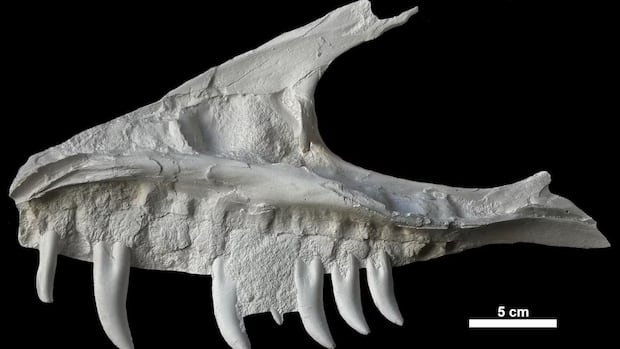
A recent study revealed that the fossilized remains of a dinosaur skull discovered in a British Columbia campground belonged to a lighter and faster tyrannosaur species compared to the well-known T. rex. Researchers from the University of Alberta examined a partial skull impression dating back 76 million years and identified it as belonging to the horned dinosaur Gorgosaurus, providing new insights into its existence in Western Canada. The findings, detailed in the journal Palaeogeography, Palaeoclimatology, Palaeoecology, shed light on the characteristics of Gorgosaurus, which could grow up to nine meters long.
The identification process began in 2017 when a B.C. resident named Rick Lambert stumbled upon a peculiar rock at a Tumbler Ridge campground. Lambert, who had experience hunting for fossils in England during his childhood, was guided to the rock by a squirrel near the riverbank. Subsequent analysis by the Tumbler Ridge Museum Foundation confirmed that Lambert had discovered the first tyrannosaurus skull ever found in B.C. Eamon Drysdale, the museum’s curator, highlighted the significance of the find, noting the rarity of bone material in the region.
The fossilized impression included the maxilla of the dinosaur’s upper jaw, offering detailed insights into its unique features despite the erosion of most of the actual bone. Researchers, led by Colton Coppock, created a detailed cast from the impression, leading to the identification of Gorgosaurus libratus. This species, which existed 76 million years ago, predates its more famous relative, the T. rex, by approximately 10 million years.
Gorgosaurus, characterized by triangular horns above its eyes, was described as a lighter and swifter tyrannosaur with longer limbs similar to a faster version of the T. rex. The study of the cast allowed researchers to compare the internal surface of the maxilla with other Gorgosaurus skull bones, providing valuable insights into the dinosaur’s anatomy. Clues linking the partial skull to Gorgosaurus included unique bone sutures and distinct features in the upper jaw.
Further analysis indicated that Gorgosaurus had a wider range of habitat than previously thought, spanning from northern British Columbia to northern Montana, covering an area of approximately 198,000 square kilometers. This discovery suggests that British Columbia holds promise as a significant area for future dinosaur research. Lambert’s find not only contributes to scientific knowledge but also symbolizes the enduring history of life on Earth, reflecting the remarkable stability of our planet.