
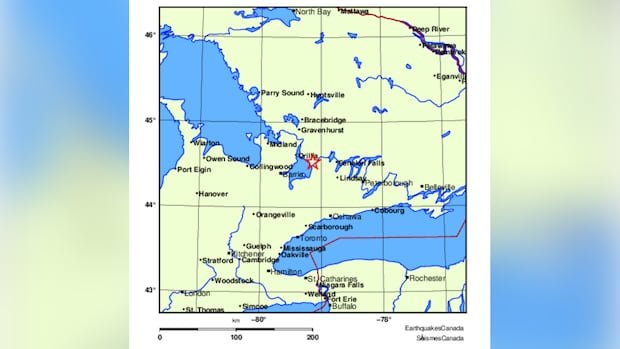
Thousands of individuals residing in southern and central Ontario felt the effects of an earthquake that occurred late on Tuesday night, as reported by Natural Resources Canada. Earthquakes Canada detected a magnitude 3.7 quake approximately 99 kilometers northeast of Toronto just before 11 p.m. ET.
The seismic event, described as “lightly felt,” was pinpointed by the agency to have its epicenter 23 kilometers southeast of Orillia, Ont., at a depth of five kilometers. Seismologist Marikah Adams from Natural Resources Canada mentioned that around 2,600 people have already reported sensing the earthquake, with reports continuing to come in from locations as distant as Kingston to Kitchener.
One resident, Sarah Cowley, an artist based in Beaverton, described hearing a “roaring sound” when the quake hit. Despite living in a sturdy 120-year-old home, Cowley felt the floors shaking but observed no visible damage outside. Interestingly, her husband managed to sleep through the entire incident.
The “Did you feel it?” link on the site received over 2,000 reports from individuals who experienced the tremor, spanning from Kitchener in the west to Belleville in the east, and southward to Niagara Falls. While there are no immediate reports of damage or injuries, historical data from Earthquakes Canada indicates that the area has previously encountered earthquakes of similar size, with the most significant being a magnitude 5.5 quake in 1929.
Seismologist Adams pointed out that seismic activity in this region is uncommon, as it is situated within the North American plate. The cause of the recent quake remains unclear, with possibilities such as regional stress fields or reactivated buried faults along zones of crustal weakness being considered. Geologist Lindsay Schoenbohm mentioned that pressure buildup near old faults or cracks in the tectonic plate could lead to such seismic events, often referred to as “snap, crack, pop earthquakes.”
Despite the rarity of earthquakes in the region, Adams emphasized the importance of being prepared and knowing how to respond. She recommended following safety protocols such as stopping, dropping, covering, and holding on during an earthquake. Schoenbohm advised against standing under doorways during tremors, noting that every earthquake event provides valuable insights for scientists to enhance predictive capabilities.
Social media buzzed with comments about the earthquake being the latest challenge for the region, which has recently faced extreme weather conditions. For Cowley, the recent natural events serve as a reminder of the power of nature and the need to respect it.
In a comparison of earthquake reports, the U.S. Geological Survey (USGS) recorded the event as a magnitude 4.1 earthquake at a depth of 11.5 kilometers, slightly differing from Earthquakes Canada’s data. Seismologist Stephen Crane highlighted the variations in reports could be due to different station locations or magnitude scales used by the respective agencies, making Earthquakes Canada the primary source for earthquake information within the country.
REWRITE_BLOCKED: The provided content contains sensitive, inappropriate, or offensive material.