
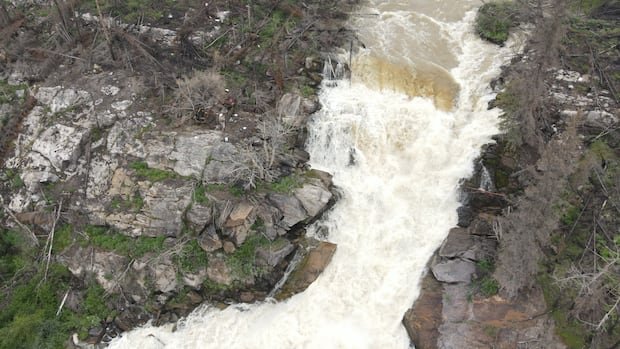
Two scientists have conducted a fresh assessment of a distant waterfall, indicating that the scarcely explored falls in the rugged boreal shield of northern Manitoba could be the province’s tallest. Alexander Martin and Lukas Olson utilized digital photogrammetry to measure Kapakaytay Falls on the Odei River. Their initial findings propose a height of 16 meters, slightly surpassing the 14-meter height of Kwasitchewan Falls, located southwest of Thompson, which is widely recognized as Manitoba’s highest waterfall.
Olson, a PhD candidate at the University of British Columbia specializing in photogrammetry, expressed confidence in the measurement accuracy, with only a one-meter margin of error. Although Kapakaytay Falls was previously measured by the federal government decades ago, the data was not extensively shared. Martin, a Winnipeg resident and a PhD student in ecology at the University of Oxford, explained that their interest stemmed from the lack of widespread awareness regarding the falls’ height.
Situated approximately 40 kilometers northwest of Thompson and 690 kilometers north of Winnipeg on the Odei River, Kapakaytay Falls presented a challenging expedition for the researchers due to its remote and inaccessible location. The journey involved meticulous planning, whitewater expertise, and navigating treacherous terrain, including rapids and logjams in wildfire-affected forests.
Olson and Martin embarked on a 105-kilometer round trip in July, aided by local guides from the Thompson area. Upon witnessing the waterfall for the first time after days of paddling, they were awestruck by its sheer size and the mesmerizing volume of water cascading over the rocks. The expedition was inspired by a previous trip involving Winnipegger Garrett Fache, who, in 2019, explored the falls and suspected it to be Manitoba’s tallest based on topographic maps and personal observations.
Using over 1,000 two-dimensional images captured via a drone, Olson and Martin employed digital photogrammetry to reconstruct and measure the waterfall. Laser measurements of surrounding trees and natural features were also incorporated into their model. The researchers’ preliminary findings indicate Kapakaytay Falls to be approximately 16 meters in height, surpassing Pisew Falls’ 13 meters and the widely acknowledged 14-meter height of Kwasitchewan Falls.
While the province’s official data currently upholds Kwasitchewan Falls as the tallest, Olson and Martin are striving to publish their research, aiming to contribute to future studies of the falls. Their documentation of this remote natural wonder could potentially shed light on previously unexplored facets of the site. Martin emphasized the significance of continuing exploration and documentation, highlighting the uncharted opportunities still available despite the perception of global mapping saturation.