
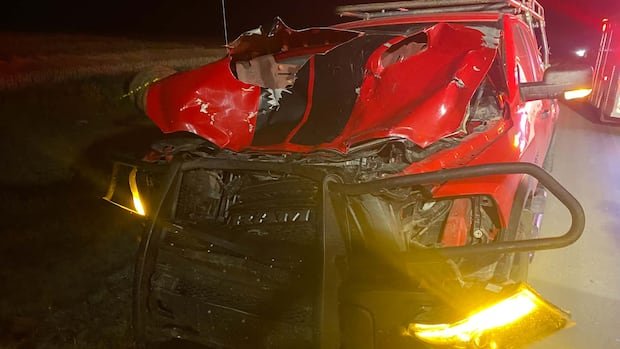
Robert Belley credits the metal bars on his truck for saving his life after a collision with a moose near Lanigan in 2024. Despite surviving, Belley continues to struggle with injuries, particularly in his left hand, limiting his ability to work in construction and impacting his income. Saskatchewan Government Insurance (SGI) warns of the increased risk of wildlife collisions during this time of year, with approximately 8,800 such incidents reported annually in the province, resulting in an average of 400 injuries and two fatalities over five years.
Belley emphasizes the seriousness of wildlife collisions, urging drivers to exercise caution and slow down on highways to prevent accidents. Troy Corbett, SGI’s director of traffic safety community engagement, notes that fall is a peak period for wildlife collisions, especially involving deer, as animals may be more active and unfamiliar with travel routes. Corbett advises drivers to stay alert, reduce speed, watch for animal signs, and use high beams when necessary to mitigate risks.
SGI recommends specific actions in case of an unavoidable collision, such as remaining calm, slowing down, and steering away from the animal. Additionally, drivers are advised to steer towards the animal’s point of origin rather than its destination and exercise extra caution during dawn and dusk when visibility may be compromised.
Bonnie Dell, executive director of the Wildlife Rescue Society of Saskatchewan, highlights the importance of promptly contacting their organization in the event of wildlife collisions. She recounts instances of rescuing injured animals, including a coyote struck by a vehicle, emphasizing the value of every individual animal and the emotional toll on drivers involved in such incidents.
Bernie Borgmann, owner of Hooker’s Towing and Recovery, shares his perspective on wildlife collisions based on his decades of experience in towing vehicles. He describes the impact of hitting animals as akin to hitting a solid wall and mentions the prevalence of such incidents in his line of work. Borgmann stresses the importance of drivers being vigilant and prepared for potential wildlife encounters to ensure road safety.