
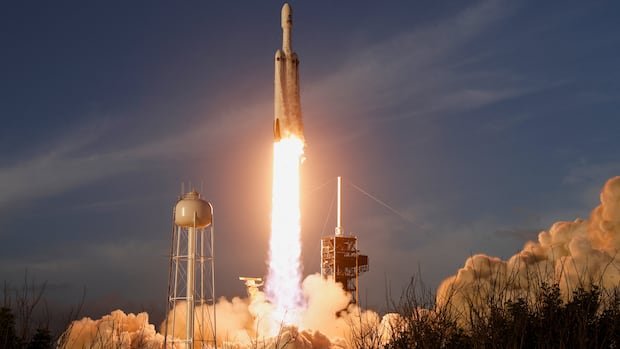
NASA has embarked on a fresh mission to explore key unknowns in astrophysics and cosmology by initiating the maiden voyage of its latest flagship astronomical observatory, the Nancy Grace Roman Space Telescope. This observatory, valued at around $4 billion, was launched from NASA’s Kennedy Space Center in Cape Canaveral, Florida, aboard a SpaceX Falcon Heavy rocket under clear skies just after sunrise. The primary objective of this five-year mission, extendable based on fuel availability, is to delve into cosmic mysteries like dark energy and dark matter, study gravity on grand scales, and seek out exoplanets beyond our solar system.
The Nancy Grace Roman Space Telescope will position itself in orbit beyond the moon to delve into cosmic enigmas and conduct extensive cosmic exploration. Originally intended for a spy satellite program overseen by the National Reconnaissance Office, the telescope was repurposed for scientific research by NASA after the former program faced budget overruns and was terminated. The observatory is set to travel towards an orbital destination known as Lagrange Point 2, situated approximately 1.6 million kilometers from Earth.
Named after NASA’s inaugural chief astronomer, who is also recognized as the “mother of the Hubble Space Telescope,” the Roman telescope is poised to revolutionize scientific observations. Over the next 90 days, mission scientists will commission the telescope and prepare for its scientific operations, with the first set of high-resolution images expected before the winter holidays, as stated by Jackie Townsend, the project manager of the Roman telescope.
NASA anticipates that the Roman Space Telescope, with its wide-angle lens capabilities, will become as renowned as other prominent orbiting observatories like the James Webb Space Telescope and the Hubble Space Telescope. Roman is projected to offer similar sensitivity and visual acuity to Hubble but with a faster surveying ability, covering the entire Milky Way galaxy in a month compared to Hubble’s estimated century timeframe. During a post-launch news conference, U.S. President Donald Trump commended the successful launch, emphasizing his support for NASA’s substantial budget.
The Nancy Grace Roman Space Telescope is poised to complement other observatories like the James Webb Space Telescope by providing panoramic views of the cosmos. The telescope will play a pivotal role in elucidating the mysterious components of dark energy and dark matter, aiming to create the most detailed 3D map of the universe to date. With its extensive survey expected to span more than two billion galaxies, Roman will aid in unraveling the mysteries surrounding the universe’s evolution since the Big Bang event approximately 13.8 billion years ago.
Roman’s comprehensive search for exoplanets is set to revolutionize our understanding of planetary systems beyond our own, potentially discovering thousands of new exoplanets. By studying the impacts of dark matter and dark energy across the universe, Roman is poised to offer unprecedented insights into these cosmic phenomena, bringing scientists closer to unraveling these long-standing mysteries.