
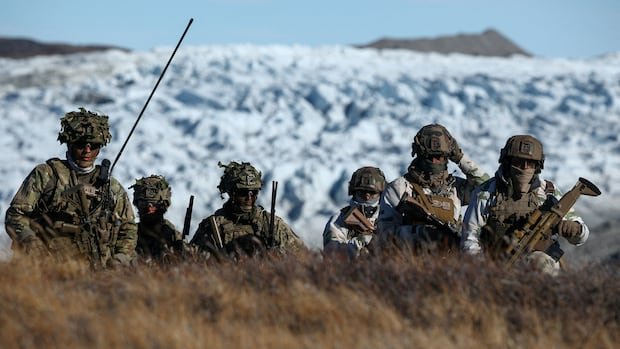
NATO Secretary General Mark Rutte demonstrated a cautious stance when addressing U.S. President Donald Trump’s recent remarks about the potential deployment of European troops in Greenland. Reports surfaced suggesting that the U.K. and Germany, among other nations, are considering a military presence on the Arctic island as a precaution against American expansionism.
Trump’s forceful rhetoric regarding Greenland and his military threats against the semi-autonomous Danish territory have brought attention to long-neglected issues within both NATO and the United States. Rutte indirectly acknowledged ongoing discussions among European nations regarding enhanced Arctic security. He emphasized that these talks are an extension of earlier dialogues initiated by seven allied Arctic nations, including the U.S., in mid-2021.
“We must collaborate to ensure the safety of the Arctic region, and we are currently deliberating on the necessary steps to achieve this goal and maintain the region’s security,” Rutte stated. The objective seems to be to convey to Trump that NATO shares his interest in bolstering defenses in Greenland.
The shift towards prioritizing Arctic security is a recent development, particularly noticeable in Washington since 2022 and further amplified during Trump’s second term. While Canada has increased its focus and financial commitments in the Far North, the broader Western military alliance has been caught off guard by heightened security demands from the U.S.
Notably, NATO lacks an official Arctic policy and a dedicated regional command, as highlighted in a recent report by the Arctic Institute Center for Circumpolar Security Studies. The alliance has historically resisted emphasizing the Far North, fearing it would detract from its primary mission of safeguarding Europe.
Regarding Greenland, the Pentagon has reassigned responsibility for the island from the U.S. European Command to the U.S. Northern Command, underscoring its significance in homeland defense strategies. There have been discussions within the academic community about potentially integrating Denmark into the North American Aerospace Defense Command (NORAD).
Independence movements in Greenland have drawn attention from U.S. policymakers, with concerns raised about the potential impact on Arctic defense dynamics. Trump’s focus on Greenland’s mineral wealth and accusations against Denmark regarding vulnerabilities to foreign influence overlook the island’s longstanding efforts to attract Western investment in its critical minerals sector.
Greenland’s rare earth mineral deposits, particularly those near Kvanefjeld and Tanbreez, have attracted interest from China, but geopolitical factors have hindered significant Chinese investments. The territory’s legislative measures restricting the development of certain mineral deposits due to uranium content have sparked political debates and opposition.
In essence, the evolving dynamics in the Arctic region, particularly concerning Greenland’s strategic importance and resources, have prompted renewed discussions and actions within NATO and among its member states.