
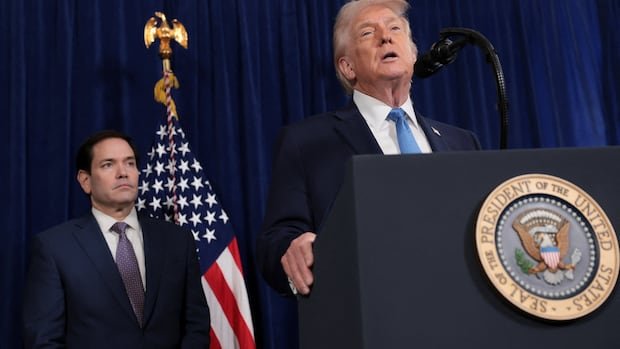
Oil prices experienced a decline on Monday morning following President Donald Trump’s announcement that the United States would refrain from attacking Iran’s energy infrastructure due to ongoing constructive discussions between the two nations. The price of a barrel of West Texas Intermediate, the primary North American benchmark, dropped by over nine percent to trade below $90 US, while stock markets saw a surge at the opening bell.
At the close of the trading day, the S&P 500 rose by 74.52 points to reach 6,581.00. The Dow climbed by 631.00 points, equivalent to a 1.4 percent increase, settling at 46,208.47, and the Nasdaq composite surged by 299.15 points, or 1.4 percent, reaching 21,946.76. Additionally, the S&P/TSX composite index saw a gain of 566.40 points, closing at 31,883.81.
President Trump announced a five-day postponement on strikes targeting Iranian power plants, citing positive discussions aimed at resolving hostilities in the Middle East. Oil prices have risen by approximately 50 percent since the onset of conflicts in the region earlier this month.
The recent statement by Trump marks a notable shift from his previous remarks over the weekend, where he issued escalating threats, warning that unless Iran fully complied with opening the Strait of Hormuz without coercion within 48 hours, the U.S. military would initiate strikes on Iranian power facilities, starting with the largest ones.
In response, the Iranian Revolutionary Guard Corps, as conveyed through Iranian media, warned of a complete closure of the Strait of Hormuz should the U.S. target Iranian energy assets. Trump has outlined military objectives for a potential war with Iran, including the degradation or destruction of Iran’s military capabilities, defense infrastructure, and nuclear program, alongside safeguarding American allies in the region.
The energy markets have witnessed a surge in prices over the past three weeks as Iran imposed restrictions on access to the vital Strait of Hormuz, a strategic route responsible for exporting 20 percent of the world’s oil, in addition to natural gas and other commodities. Analysts at energy consultancy Wood Mackenzie have suggested that oil prices could reach $200 per barrel in 2026 if disruptions in Gulf exports persist.
Once the conflicts subside, it is anticipated that a few months will be required for the energy markets to stabilize. Kurt Barrow, an analyst specializing in oil, fuels, and chemicals at S&P Global, emphasized the ongoing energy crisis, highlighting shortages of around 15 million barrels per day, encompassing not just crude oil but also jet fuel, diesel, and gasoline.
The North American oil sector is currently in a state of uncertainty, with potential repercussions if prices escalate significantly over an extended period, potentially leading to reduced oil demand in the face of a global economic downturn and escalating fuel costs. Kevin Krausert, former Alberta drilling executive and current CEO of Avatar Innovations, expressed the industry’s cautious outlook amid escalating oil prices, underscoring the global energy sector’s responsibilities during this critical period.
President Trump’s social media post concerning potential strikes coincides with the fourth week of the conflict with Iran.