
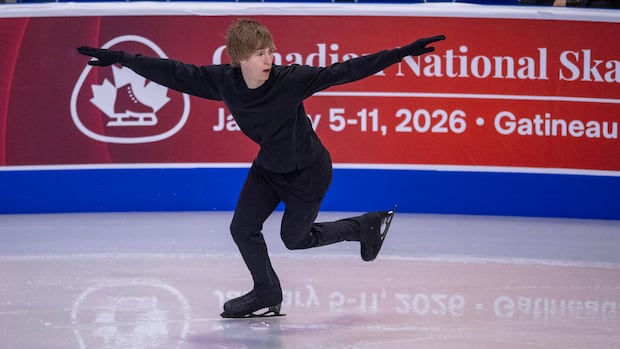
Brian Orser is aware that Canada faces long odds in securing a singles figure skating medal at the Milano-Cortina Winter Olympics.
The 1987 world champion and esteemed coach is not worried, as he believes improved outcomes are on the horizon.
“When we appear to be in a lull, it’s often because something is developing and building up,” Orser remarked. “Then suddenly, it reaches a boiling point, and everyone is elated.”
“We just need to practice patience.”
For many decades, Canadian singles skaters have been prominent on the global stage, consistently bringing home a remarkable collection of medals.
As a young boy, Orser looked on in admiration from his living room in Penetanguishene, Ontario, when the groundbreaking Toller Cranston captured an Olympic bronze in 1976, setting a precedent for future Canadian athletes.
-
How to watch Milano-Cortina Olympics on CBC
-
Canadian ice dancers Gilles and Poirier ride a long road to another Olympics
Orser carried that legacy forward with two Olympic silver medals and a world championship title in the 1980s, motivating fellow world champions Kurt Browning and Elvis Stojko, who collectively earned six titles in eight years during the 1990s, paving the way for skaters like Jeffrey Buttle and Patrick Chan.
“In any sport and in any nation, there are cycles, and we experienced a long period of having reigning men’s champions,” Orser noted last month at the Canadian championships held in Gatineau, Quebec, where he coached several competitors. “Eventually, that trend might pause for a while.”
Although Canada has not been as dominant in women’s figure skating, the country has still produced Olympic medallists such as Elizabeth Manley (1988), Joannie Rochette (2010), and Kaetlyn Osmond (2018) over the last four decades.
Strong lineage
The robust lineage of Canadian figure skating makes the current lack of medals particularly noticeable. Since Osmond’s victory in 2018, no Canadian has secured a singles medal at the Olympics or world championships — and no male skater has achieved this since Chan in 2014.
Orser admits he cannot pinpoint the reasons behind the fluctuations in Canadian figure skating.
“You could drive yourself mad trying to understand why these cycles occur,” he stated. “It’s not solely about coaching or the talent available; sometimes, it’s merely a matter of timing.”
Browning also shared his thoughts on the singles situation, suggesting that part of the explanation lies in the significant changes in the sport worldwide. He highlighted that Japan, now a dominant force, hardly contested for men’s podium positions during his competitive years.
The four-time world champion also mentioned that people tend to become accustomed to success and seldom question it.
The 2018 Olympic gold-medal team, which featured Chan, Osmond, and ice dancers Tessa Virtue and Scott Moir, he remarked, “was a unique collection of skaters” — not typical.
“When you drive to work for the hundredth time and arrive safely, you don’t give it a second thought. But if you have a minor accident, you start questioning everything,” Browning explained in a phone interview. “That’s what happens when we don’t replicate past successes.”
“We simply haven’t enjoyed the same level of success in the last eight years, but it’s a tough act to follow for anyone.”
Gogolev, Schizas are Canada’s only singles entries
Stephen Gogolev and Madeline Schizas represent Canada as the sole singles competitors in Milan, instead of the maximum of three men and three women allowed.
Both were crowned national champions in January and have had strong seasons, though either reaching an individual Olympic podium is a significant challenge.
Where Canada’s singles skaters might find an opportunity is in the team event, which commences Friday at Milano Ice Skating Arena.
Schizas, a 22-year-old from Oakville, Ontario, excelled under pressure during the 2022 Games, finishing second in both the short program and free skate as Canada’s team placed fourth.
“That’s where my shot at a medal lies,” Schizas stated, having achieved a career-best 11th place in singles at last year’s world championships in Boston.
“We will obviously require strong performances across the board, particularly in the singles disciplines during the short program.”

Madeline Schizas displays her gold medal from the women’s figure skating competition at the 2026 Canadian National Skating Championships in Gatineau, Quebec, on January 11. (Justin Tang/The Canadian Press)
Gogolev was viewed as a potential frontrunner for Canadian singles after landing his first triple axel at the age of 10 and winning the Junior Grand Prix Final just days before turning 14 — during which time Orser was his coach — but he faced setbacks due to a significant growth spurt and back issues that affected his training.
Now 21 and back in good health, the Toronto native has delivered impressive results this season, with scores that could contend for a top-10 finish. His outstanding performance at nationals in January secured his place at the Olympics.
Ten nations will compete in the team event, with the top five after the short programs advancing to the finals. The United States and Japan are anticipated to vie for gold and silver, while Canada — with Russia absent — may compete with Italy and Georgia for the bronze medal.
“If both Maddie Schizas and Stephen Gogolev perform at the level they showcased at nationals, there’s a strong chance they can help Canada secure a podium finish,” Browning, who will appear on CBC’s Olympic coverage, said. “I believe the margin for that bronze medal is quite narrow.”
Looking ahead beyond Milan, Orser remains optimistic that the cycle for Canadian singles skating will eventually turn positive again. He highlights Skate Canada’s Next Gen program and the promising junior talent Lia Cho.
The 13-year-old Cho, hailing from Calgary, set a new Canadian junior record at nationals in January with a score of 199.60 points — a tally that would have earned her a silver medal in the senior category.
“She’s an extraordinary natural talent, and such talents emerge sporadically,” Orser remarked. “Talents like hers appear in Korea, in Japan, in Russia, and in the United States, and we have one in Canada.
“I can’t predict the future, so I don’t know how she will develop over the next five years, but I believe she will be quite exceptional.”