
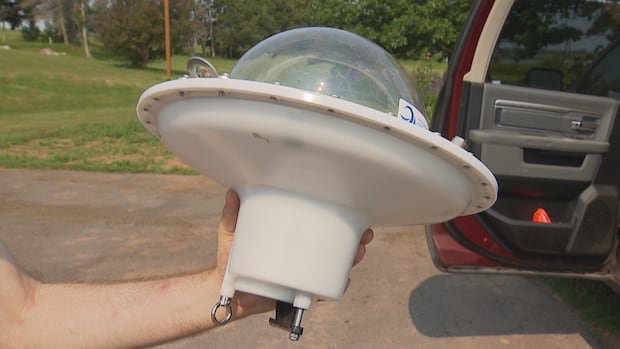
New monitoring devices for algae will be placed in three different water bodies on Prince Edward Island this summer as part of a trial project to gain a better understanding of blue-green algae blooms. Kyle Knysh, a provincial surface water biologist, mentioned that blue-green algae, also known as cyanobacteria, has been observed throughout the Island in recent times.
The deployment of three algae trackers is planned for MacLures Dam in Murray River, Parsons Creek in Stanhope, and Point Deroche Pond near Blooming Point. Knysh highlighted that the main objective of these trackers is to analyze the frequency and duration of blooming conditions, which can also serve as a tool to monitor potential high levels of the bacteria for public health safety.
P.E.I.’s environmental health division emphasized that toxins from blue-green algae can pose health risks to both humans and animals, with exposure possible through contact with or ingestion of contaminated water. Symptoms of exposure may include skin irritation, eye irritation, stomach upset, and in rare cases, more severe illnesses. The public is advised to avoid water with visible blue-green algae blooms, adhere to local health advisories, and keep children and pets away from affected areas.
In addition to health concerns, Knysh mentioned environmental issues associated with blue-green algae blooms. Large blooms can generate organic matter that sinks to the bottom of waterways, further reducing oxygen levels in certain systems.
The prevalence of blue-green algae in various water bodies on P.E.I. has been increasing, attributed to factors such as climate change, rising temperatures, nutrient availability, and water column stability. These factors interact in different ways to create favorable conditions for blue-green algae growth. Notably, at Parson’s Creek, high levels of blue-green algae persisted until the water froze over.
The introduction of a new algal tracker in Parson’s Creek aims to shed light on the reasons behind the elevated levels of bacteria in that specific location compared to others in the region. Recognizable signs of blue-green algae include water appearing scummy, resembling pea soup, or as if green paint has been spilled in it. Individuals suspecting blooming conditions can contact P.E.I.’s Land and Environment Department for further investigation.