
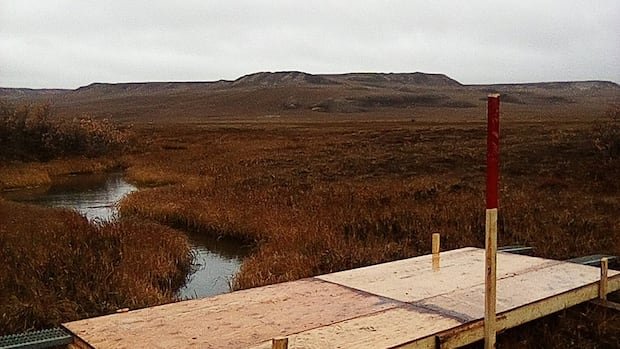
A series of small bridges constructed around Paulatuk, N.W.T., are providing a safer route for harvesters to access their camps amid escalating hazards posed by climate change. These flat bridges, made of lumber and plywood, are strategically placed over frequently-crossed creeks that are increasingly susceptible to sudden flooding, accommodating the passage of all-terrain vehicles.
The initiative was conceived by former Paulatuk Community Corporation employee Dianne Ruben, who co-led the project until recently. Reflecting on the foresight of their ancestors, Ruben emphasized the necessity to adapt to changing conditions. The endeavor, championed by the Paulatuk Community Corporation, received backing from the Paulatuk Hunters and Trappers Committee and the Inuvialuit Regional Corporation’s Innovation, Science, and Climate Change department. The project, with a budget of approximately $32,000, was executed by a committee comprising representatives from the Community Corporation and Hunters and Trappers Committee.
According to Ruben, Paulatuk already boasts six mini-bridges, with plans for an additional seven in the pipeline. The locations for these bridges were pinpointed by a team of seasoned local harvesters under the guidance of Steve Illisiak, who also served as the field leader for the initiative.
Mayor Ray Ruben of Paulatuk underscored the significance of the mini-bridges during a community meeting, recounting a previous incident where several harvesters encountered a perilous situation crossing a creek post-hunt due to heavy rainfall and flooding. Diane Ruben highlighted the two primary access routes to the traditional lands around Paulatuk, emphasizing the risks posed by permafrost slumps along coastal paths and the subsequent need for safer inland routes.
Ruben shared a personal anecdote about a close call while gathering firewood on the beach, underscoring the escalating dangers associated with coastal travel. The implementation of the bridges has been met with relief and gratitude by the community, with hopes for further expansion. Ruben aspires for this project to serve as a model for other communities grappling with climate-related transformations in their landscapes.