
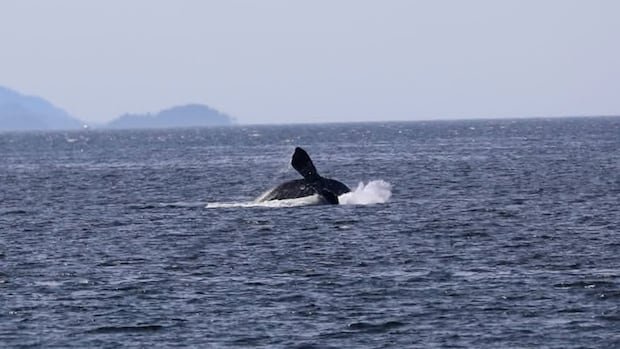
Troy Bright, a seasoned whale researcher stationed off Malcolm Island, had a unique encounter on Sunday when he sighted a previously unseen whale breaching multiple times. With over three decades of experience documenting whales with Bere Point Research, Bright quickly grabbed his camera to capture this rare find. Noticing distinct short and dark pectoral fins, he identified it as an endangered North Pacific right whale, the rarest and most endangered whale species globally.
Jared Towers, a cetacean research technician from the Department of Fisheries and Oceans (DFO) residing in Alert Bay, embarked on a search for the whale and eventually located it rolling at the surface with a piece of kelp, a behavior that made spotting it challenging. This juvenile North Pacific right whale, measuring around eight meters in length, holds significant importance as sightings of this critically endangered species in British Columbia are extremely rare.
The recent sighting is a positive sign for the dwindling population of fewer than 50 North Pacific right whales, as it is believed to be a calf, indicating recent reproduction within the group. While much remains unknown about these whales, researchers are hopeful that further study and protection efforts can shed light on their behavior and habitat needs. Previous collaborative efforts involving sonobuoys to detect the unique “gunshot calls” of North Pacific right whales near Haida Gwaii have provided valuable insights.
Researchers, both in Canada and the United States, are closely monitoring the situation, acknowledging the historical impact of human activities on the species’ decline. Kevin Campion, founder of Save the North Pacific Right Whales, emphasized the need for conservation efforts to aid in the recovery of these majestic creatures that were decimated by past hunting practices, lack of prey availability, and threats from ship strikes and entanglements. The sighting offers hope for understanding and safeguarding these magnificent animals and their vital ocean ecosystems.