
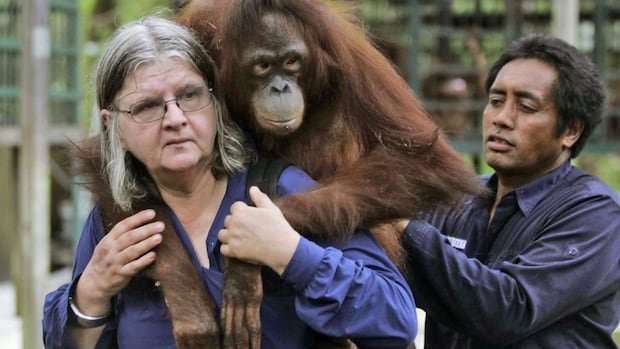
Renowned Canadian scientist Biruté Mary Galdikas, known for her lifelong commitment to the research and protection of orangutans, has passed away at the age of 79. Galdikas succumbed to lung cancer in Los Angeles early Tuesday morning, surrounded by her loved ones, as confirmed by the Orangutan Foundation International, an organization she established in 1986 to advance her studies in Borneo, Indonesia.
Described by Ruth Linsky, a doctoral candidate at Simon Fraser University, as a figure of unwavering devotion to orangutans, Galdikas dedicated her efforts to the well-being of these primates. Linsky, who worked closely with Galdikas at the Borneo research station, emphasized Galdikas’s singular focus on the orangutans, portraying her as a truly exceptional individual.
Galdikas’s five-decade tenure in Indonesia solidified her status as a preeminent authority on orangutans, allowing her to advocate passionately for their conservation. Her establishment of a research station within Tanjung Puting National Park significantly contributed to the preservation of the largest remaining wild orangutan population.
Against initial skepticism from academic circles, Galdikas embarked on her groundbreaking research in 1971 in Tanjung Puting, accompanied by her then-husband, photographer Rod Brindamour. Overcoming challenges posed by the elusive nature of orangutans, she meticulously documented various aspects of their lives, including dietary habits, social behaviors, and reproduction patterns.
Acknowledged by Isabelle Laumer, a primatologist at the Max-Planck-Institute for Anthropology, Galdikas’s work shed light on the vulnerability of orangutans to habitat loss due to their slow reproduction rates. Galdikas’s efforts extended beyond research, as she established a rehabilitation center aiding in the return of captive orangutans to their natural habitat.
Galdikas’s legacy culminated in the designation of Tanjung Puting as a national park in 1983, a testament to her instrumental role in orangutan conservation. Her profound connection with these primates stemmed from a deep-seated curiosity about human origins and our place in the world.
Recognized for her pioneering contributions, Galdikas was honored with numerous awards, including the Tyler Prize for Environmental Achievement and the United Nations Global 500 Award. Her passing marks the end of an era for the trio of “trimates,” alongside Jane Goodall and Diane Fossey, who collectively revolutionized primatology.
Galdikas’s impact on orangutan ecology, conservation, and public awareness resonates profoundly within the scientific community and beyond. Her enduring legacy serves as a cornerstone for ongoing efforts to protect orangutans and their natural habitats. She is survived by her three children and grandchildren.