
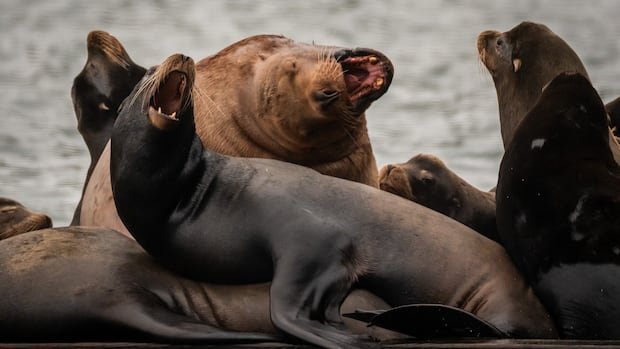
Sea lions have returned for their annual migration to Howe Sound in British Columbia, where they have claimed two private docks, filling West Vancouver with their loud barking and bellowing. Mayor Mark Sager has acknowledged receiving complaints about the noise but suggests residents appreciate the sea creatures’ presence as a natural phenomenon.
Last year, sea lions took over a dock near Garrow Bay Park, which has since been fenced off to prevent their access. Alex Cole, a local resident, witnessed the sea lions’ arrival in December and described them as large, vocal, and lively animals with distinct personalities. Cole has set up a Facebook group for sharing wildlife sightings in Howe Sound.
Experts note the appearance of two sea lion species, Steller and California, each with unique behaviors and sounds, indicating a thriving ecosystem. Steller sea lions, native to British Columbia, are the largest among sea lions, known for their sensitivity despite their size. On the other hand, California sea lions, characterized by their loudness, create a boisterous atmosphere akin to a biker gang gathering when they arrive.
The abundance of anchovies in Howe Sound in recent years has attracted various marine life, including sea lions, seals, and humpback whales. Andrew Trites from the University of British Columbia’s Marine Mammal Research Unit highlighted the unexpected increase in wildlife activity in the region due to the availability of fatty fish.
California sea lions typically inhabit British Columbia waters from November to March before returning to California for breeding. In contrast, Steller sea lions migrate to breeding grounds in B.C., with their population on the rise. Trites emphasized the importance of coexisting with these animals and celebrating their resurgence in Howe Sound as a testament to the area’s ecological recovery.