
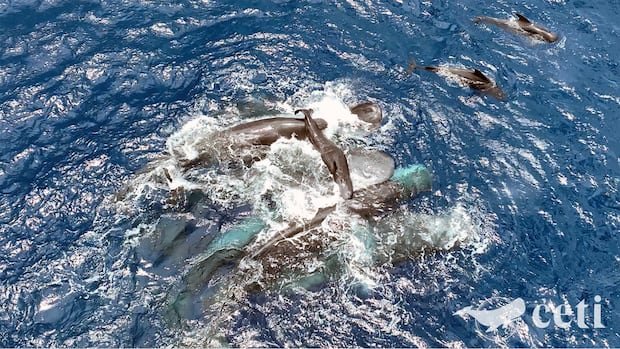
Rare footage capturing a sperm whale giving birth has provided scientists with valuable insights into the behavior of these massive and elusive marine mammals. The video, filmed in 2023, showcases female whales from two distinct family lines collaborating to aid in the birthing process and raising the newborn calf above the water surface.
This remarkable level of coordination, seldom seen in the animal kingdom outside of primate species like monkeys and humans, sheds light on the unique social dynamics of sperm whales. Historical records of sperm whale births over the past six decades have been limited, mostly anecdotal, or derived from whaling expeditions.
In a recent study featured in the journal “Science,” researchers documented this exceptional event, utilizing drone footage to observe and analyze the cooperative efforts among both related and unrelated sperm whales during the birth process.
On a ‘surreal’ morning in July 2023, scientists studying whale communication off the coast of Dominica witnessed an extraordinary sight. Eleven whales, predominantly females, surfaced together, engaging in synchronized movements above and below the water’s surface. Promptly deploying drones and microphones, the researchers captured the entire birthing process, which lasted approximately 30 minutes.
Following the birth, pairs of whales supported the newborn calf above the water until it could swim independently. Study co-author David Gruber from the Cetacean Translation Initiative described the event as truly exceptional, highlighting the collective efforts of the whales during this crucial moment.
The researchers later developed software to analyze the birthing process, noting the significant involvement of mothers, sisters, and daughters, even including unrelated individuals. These observations underscore the close-knit, female-led social structure of sperm whales and how these bonds extend to pivotal and vulnerable moments in their lives.
Canadian co-author Shane Gero, affiliated with Project CETI, expressed amazement at how these animals come together to overcome challenges, emphasizing the significance of their collective actions during such moments.
Additionally, scientists observed unique vocalizations from the whales during the birth, including distinctive patterns of clicks. A subsequent report published in “Scientific Reports” detailed these findings, suggesting that the sounds could facilitate communication and synchronization among the whales during the birthing process.
These discoveries raise intriguing questions about the formation and coordination of whale groups during such events. While answers may be elusive due to the rarity of such footage, the research provides valuable insights into the hidden communications and social dynamics of sperm whales.
Biologist Susan Parks of Syracuse University, not involved in the studies, remarked on the excitement of exploring the social lives of these fascinating marine creatures, highlighting the significance of these findings in understanding their intricate interactions.
The newfound knowledge gleaned from this research offers a glimpse into the complex and cooperative behaviors exhibited by sperm whales during critical moments, providing a deeper understanding of their social structures and communication methods.