
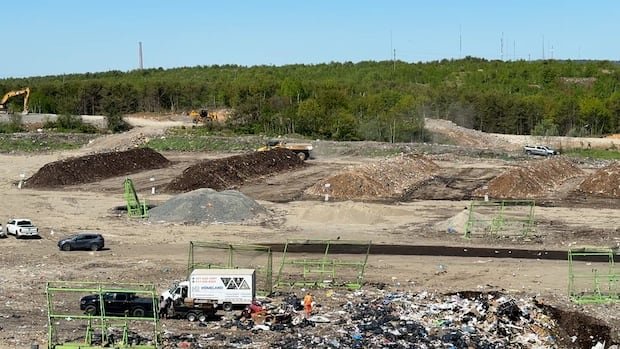
The City of Greater Sudbury anticipates that its three landfills will reach full capacity in approximately 25 years if current waste disposal practices continue. Renée Brownlee, the city’s director of environmental services, highlighted that about 30% of landfill content consists of organic waste that could instead be diverted to composting facilities. However, only 40% of eligible low-density households take part in the city’s green bin program.
Introduced in 2009, the green bin program initially saw a participation rate of 27% in 2018. This figure rose after the city implemented a bi-weekly two-bag limit for garbage collection, with green and blue bin pick-ups occurring weekly. Brownlee emphasized the need for increased organic waste diversion, pointing out that while the blue box program boasts a 97-98% participation rate, there is still considerable room for improvement in organic waste management.
To extend the lifespan of existing landfills, the city estimates that building a new landfill would cost a minimum of $200 million, subject to approval from Ontario’s Ministry of the Environment, Conservation, and Parks, a process that could span a decade. Alternatively, constructing an incinerator would likely be more costly, as exemplified by Ottawa’s $450 million incinerator project under consideration.
Brownlee underscored that diverting 100% of recyclable materials within the community, both residential and non-residential, could effectively double the current landfill lifespan. To boost green bin program participation, the city is considering two options – mandating the use of clear garbage bags for household waste and implementing a pay-per-use system where residents are charged for each garbage bag they utilize.
Encouraging green bin usage not only aids in extending landfill longevity but also plays a crucial role in reducing the city’s greenhouse gas emissions. Organic waste decomposing in landfills generates methane, a potent greenhouse gas. While the city captures some methane at its primary landfill for electricity production, not all emissions are collected. Furthermore, the city tests and sells compost generated from organic waste, with compliant compost distributed for public use and the remainder utilized for various industrial applications.