
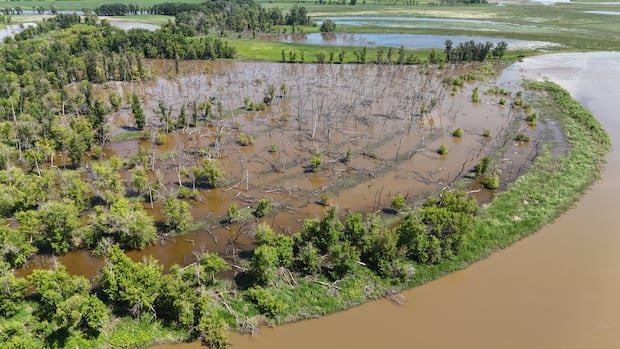
In 2025, many residents of Manitoba faced challenges from forest fire smoke in the summer. This year, some are dealing with flooded fields, waterlogged basements, and damage from severe storms.
The fluctuation between dry spells and heavy rainfall is disorienting, particularly in a region like Manitoba with its highly changeable midcontinental climate.
The recent unexpected disaster of summer flooding differs from the more common slow and predictable spring floods. This sudden and intense phenomenon caught many off guard, especially in the Parkland areas of Swan River, Minitonas, and Dauphin, which are not accustomed to such extreme weather events.
To understand the recent events and potential future scenarios, let’s delve into the geography and climate science that shed light on the unusual summer conditions:
**How were the Parkland communities surprised by floods?**
Swan River and Minitonas are situated in the Swan Valley, a small drainage basin within the Lake Manitoba watershed. Dauphin is nestled within a break in the Manitoba Escarpment.
Unlike the flat terrain of the Red River Valley, the Parkland regions are surrounded by hills. Minitonas lies on the north slope of the Duck Mountains, Swan River is between the Ducks and the Porcupine Hills, and Dauphin is positioned southeast of the Ducks and north of Riding Mountain.
When heavy rains hit the Parkland areas, the rivers and streams flowing down these hills rise rapidly compared to the slow rise of the Red River Valley’s winding rivers.
“This leads to swift floods that do not give much warning time, unlike those originating from the U.S. border, which can take days to arrive,” said Jay Doering, a top hydrologist and professor emeritus of civil engineering at the University of Manitoba.
The combination of prolonged, recurring storms and the topography of the region set the stage for significant damage. Meteorologists found it challenging to predict precisely where the heaviest rainfall would occur in the Parkland.
**Extreme weather events or a new climate pattern?**
The unusual heavy rainfall in the Parkland region stands out, reflecting the increased frequency of extreme weather events expected in Manitoba’s already variable climate.
Danny Blair, co-director of the Prairie Climate Centre in Winnipeg, highlighted that while not every weather event can be directly attributed to climate change, it likely played a role in the recent extreme conditions experienced in Manitoba.
Long-term projections indicate that the jet stream in the northern hemisphere will become more erratic due to rapid Arctic warming. This shift can lead to more frequent and severe storms, particularly when coupled with high moisture levels in the air.
**Which areas remain vulnerable?**
While the rivers and streams in the Parkland areas rise and fall quickly, the floodwaters draining from the Porcupine Hills, Ducks, and Riding Mountain flow into the already flooded Assiniboine River.
The Assiniboine River hit a record crest near the Saskatchewan border and is still rising, with further record crests expected at St-Lazare. Forecasters anticipate the river to crest in Brandon between July 12 and 15 at levels approaching records.
**Outlook for the lower Assiniboine and Lake Manitoba**
Excess flows on the Assiniboine River are diverted north of Portage la Prairie to Lake Manitoba. This diversion helps prevent flooding closer to Winnipeg, where the river sits above the surrounding floodplain.
The Portage Diversion, critical in managing river flows during extreme events, has not seen significant use this year. Lake Manitoba currently maintains ample capacity and is below flood stage.
**Any silver lining in the midst of challenges?**
The summer flooding in Manitoba is expected to have a substantial financial impact, affecting agricultural yields and causing damage to properties. The total cost remains uncertain, with government assistance programs aiming to bridge gaps.
Amidst the challenges, Manitoba Hydro emerges as a potential beneficiary. Lake Winnipeg’s water levels have risen significantly, offering increased revenue for the utility. This boost in revenue might offset repair costs from storm damage, possibly leading to a positive financial outcome for Manitoba Hydro in the current fiscal year.
The recent weather extremes in Manitoba highlight the importance of preparedness and understanding the evolving climate patterns in the region.