
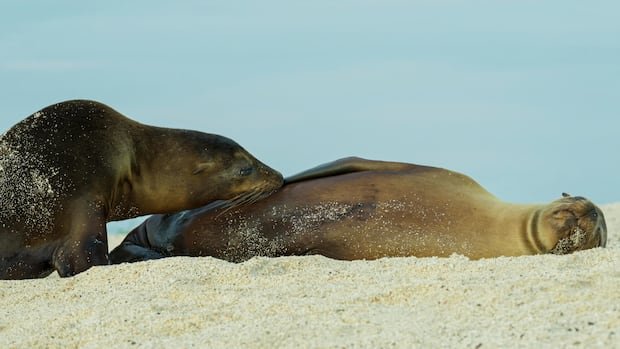
A recent study by researcher Alexandra Childs sheds light on the intriguing behavior of fully grown Galápagos Islands sea lions continuing to suckle from their mothers. Childs, a PhD candidate in behavioral and marine biology at the University of Bielefeld in Germany, expressed surprise at this phenomenon, stating that approximately 11% of the sea lion population persist in nursing well into adulthood, which is akin to humans breastfeeding into their teens and twenties.
The study, published in the American Naturalist journal, analyzed two decades of data on Galápagos sea lions, scientifically known as Zalophus wollebaeki. While most sea lions wean off their mothers between 1.5 and 4.5 years of age, the “supersucklers” defy this norm by continuing to nurse beyond maturity. The oldest observed individual suckling was 16 years old.
Notably, this behavior, termed “supersuckling,” is more pronounced in the Galápagos sea lions compared to other species. Andrew Trites, from the University of British Columbia, noted that such behavior is linked to food scarcity in other sea lions and seals, where mothers provide milk to ensure offspring survival and reproduction. However, in the case of Galápagos sea lions, supersuckling was more frequent during periods of abundant food resources, contrary to the expected trend of scarcity driving this behavior.
While the study hints at possible bonding or social aspects of supersuckling, further research is necessary to fully understand this behavior. Childs emphasized the need for continued study on this intriguing phenomenon, suggesting potential immunological or social benefits that remain undiscovered.