
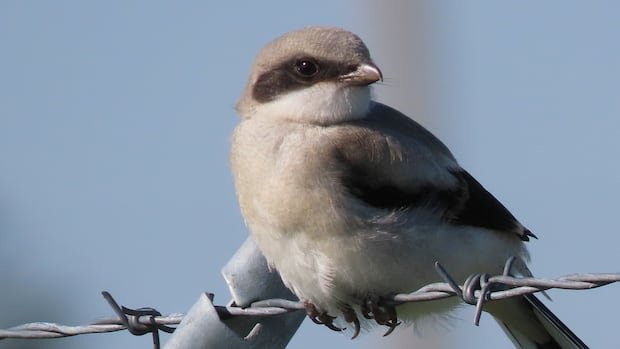
The loggerhead shrikes, commonly referred to as “butcher birds,” may look gentle with their soft feathers and plump appearance. However, these birds exhibit a ruthless behavior during feeding time, capturing prey like insects, rodents, and amphibians, and skewering them on thorns or barbed wire before consuming them.
Found mainly in Saskatchewan, loggerhead shrikes are facing threats to their habitats, as noted by Saskatoon birder Kerry Hjertaas, who witnessed these birds in action near his workplace. Hjertaas recounted an incident where he observed shrikes impaling prey on a barbed-wire fence and feeding voraciously alongside another shrike, a sight he found fascinating.
According to Emily Putz, the habitat stewardship co-ordinator of Nature Saskatchewan’s shrubs for shrikes program, shrikes adopt this hunting technique due to their lack of talons, being songbirds. She emphasized that shrikes in Saskatchewan display this unique behavior, making them a remarkable species to observe.
With an estimated population of around 40,000 in Saskatchewan, loggerhead shrikes are classified as a threatened species, just one step away from being endangered. The primary challenge these birds face is habitat loss, with only a small percentage of native prairie remaining in Saskatchewan. To adapt, shrikes have started nesting and hunting in shelterbelts, which are shrubs encircling fields.
However, the removal of shelterbelts by some landowners and farmers poses a further threat to shrikes. This loss of both native and adapted habitats is putting pressure on the species, leading to potential relocations in the future. Despite the challenges, efforts are being made to protect shrikes, with annual surveys conducted by Nature Saskatchewan to monitor populations and sightings reported by wildlife enthusiasts like Hjertaas.
To aid in the conservation of shrikes, individuals can contribute by planting shrubs such as buffalo berry and hawthorn, providing essential resources for these unique birds. By supporting these efforts, it ensures the preservation of shrikes for future generations to appreciate their presence in the ecosystem.